
If you have spent time setting up a Google Ads campaign, few things are more frustrating than seeing a little yellow warning label next to your keywords that reads: “Low search volume.” When this happens, Google essentially puts those keywords on pause. Your ads won’t trigger, your budget won’t spend, and you are left wondering what went wrong.
The good news is that this isn’t a permanent penalty on your account. It is just a data signal. Let’s look at what this status actually means, why Google does it, and the simple ways you can get your ads moving again.
What Does “Low Search Volume” Actually Mean?
Google flags a keyword with this status when it has very little to no search history on the internet.
- It’s a protective pause: Google wants to keep its system efficient. If a keyword is searched only once or twice a year, Google temporarily disables it so its systems don’t waste energy tracking it.
- It is dynamic: This status isn’t permanent. If suddenly a town or a trend makes that keyword popular, Google will automatically reactivate it and start running your ads again.
- It stops your impressions: While the keyword sits in this status, it won’t participate in ad auctions, meaning your ads won’t show up for that specific phrase.
Common Reasons Your Keywords Have Low Search Volume
Before trying to fix the issue, it helps to understand how your keywords ended up with this label in the first place. Usually, it comes down to being a bit too specific.
- The terms are too long or specific: Long-tail keywords are great for targeting, but if you string five or six highly specific words together, chances are almost nobody is typing that exact phrase into Google.
- Example: Using a phrase like “left-handed blue running shoes size 11 in downtown Austin”.
- You are targeting a tiny geographic area: If you pair a niche keyword with a very small geographic radius, the pool of potential searchers shrinks to near zero.
- Example: Targeting a specialized service only within a single zip code or a small neighborhood.
- It is a brand-new product or industry: If you have invented a brand-new type of software or a unique product that people don’t know exists yet, they won’t be searching for it by name.
- Example: Trying to bid on your brand name when your company just launched yesterday and has zero brand awareness.
- Overly restrictive match types: Using exact match brackets on a phrase that already has a low number of searches leaves the algorithm with absolutely zero room to find similar searches.
- Example: Setting the keyword
[organic gluten free sugar free dark chocolate dallas]to an exact match.
Simple and Effective Ways to Fix It
Fixing a low search volume issue is all about opening up the gates just enough so Google has data to work with, without throwing your budget away on irrelevant clicks.
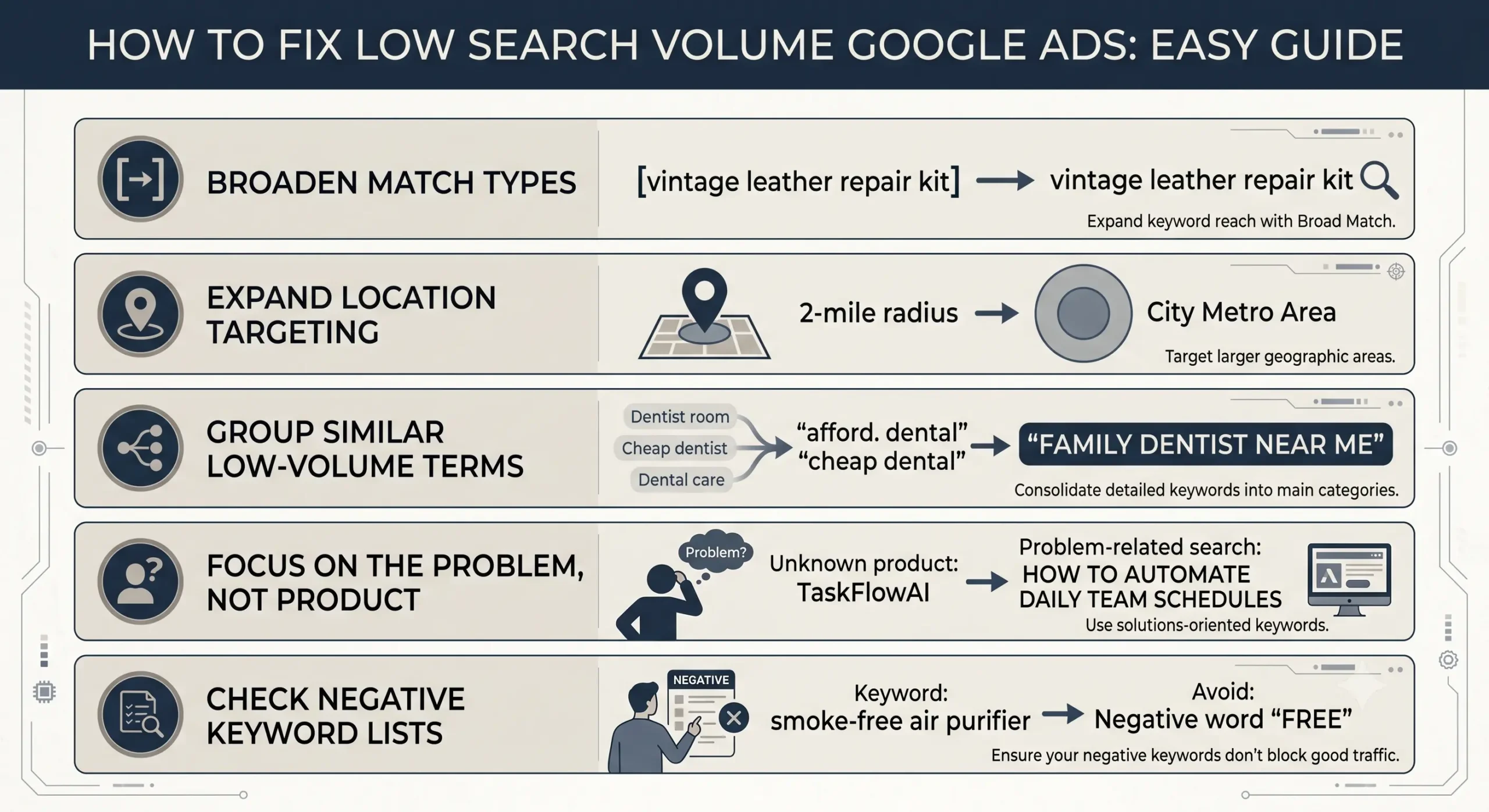
- Broaden your match types: If your keyword is locked inside an exact match or phrase match setting, try changing it to broad match. This allows Google’s AI to show your ad for related terms, synonyms, and variations that do have healthy search volumes.
- Example: Changing
[vintage leather repair kit]to just vintage leather repair to capture broader, related user intents. - Zoom out on your location targeting: If your campaign is limited to a small town or a tiny radius, consider expanding your target to the entire city, county, or state. You can always use location bid adjustments later if you want to prioritize closer customers.
- Example: Instead of targeting a 2-mile radius around a storefront, open the targeting up to the entire city metro area.
- Group similar low-volume terms together: If you have ten different keywords that all say “low search volume” but mean roughly the same thing, try pausing them and replacing them with one or two slightly more general parent terms.
- Example: Pausing detailed variations like “affordable family dentist room” and “cheap dentist for families” and using a single parent term like “family dentist near me”.
- Focus on the underlying problem, not just the product: If you sell a brand-new tool that no one searches for, look for keywords related to the problem it solves. Target terms that people already look up when they are frustrated, and use your ad copy to introduce your product as the solution.
- Example: Instead of bidding on an unknown software name like “TaskFlowAI”, target what people are struggling with, such as “how to automate daily team schedules”.
- Check your negative keyword lists: Sometimes, a broad negative keyword you added to save money might accidentally be blocking your specific keywords from getting any traffic.
- Example: If you added the negative keyword “free” to avoid budget waste, but you are trying to bid on the keyword “smoke-free air purifier”, your ad will be completely blocked from showing.
Summary
A “Low Search Volume” status is simply Google’s way of telling you that your targeting parameters are a bit too narrow for its system to function. By widening your keyword phrasing, loosening up tight location restrictions, transitioning to broader match types, and focusing on user intent rather than hyper-specific product names, you give the Google Ads algorithm the breathing room it needs to find your audience and kickstart your campaigns.