
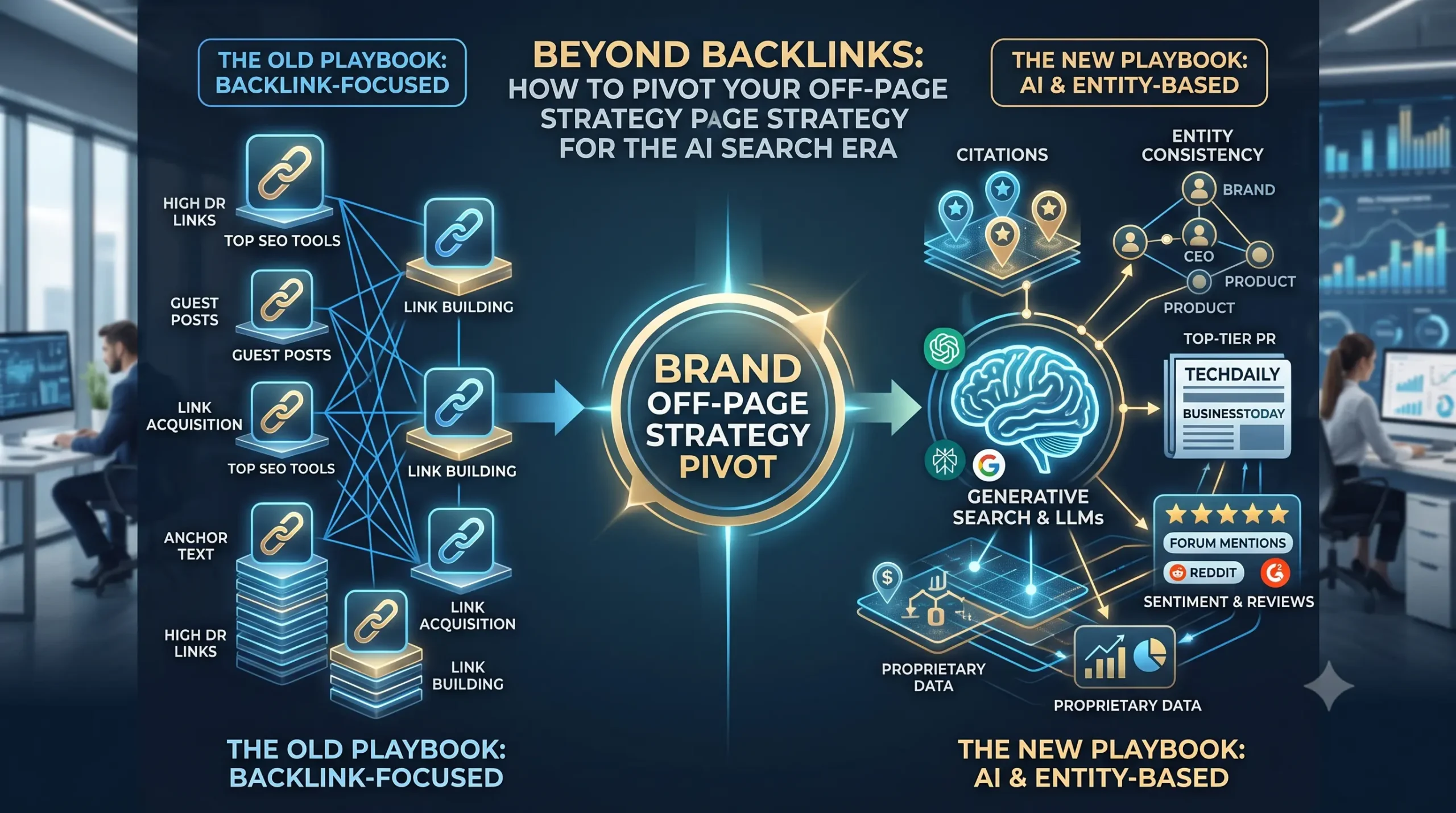
For over two decades, the off-page SEO playbook was simple: acquire high-authority backlinks, optimize anchor text, and watch your domain authority climb. If on-page SEO was about creating great content, off-page SEO was strictly a vote-counting exercise powered by hyperlinks.
Then came generative search.
With AI Overviews, Perplexity, ChatGPT, and Claude dominating how people discover information, the mechanics of search have fundamentally shifted. Users are no longer presented with a simple list of ten blue links; they receive synthesized, direct answers. In this new landscape, winning off-page SEO isn’t just about getting a web crawler to follow a link—it’s about convincing large language models (LLMs) that your brand is an undisputed, cited source of truth.
If your off-page strategy still focuses entirely on backlink volume and PageRank metrics, you are optimizing for a search engine model that is rapidly fading. Here is how off-page authority has evolved and what you need to do to pivot your strategy for the AI era.
1. What Has Changed in Off-Page Strategy?
To understand how to pivot, you first need to understand how Large Language Models evaluate authority compared to traditional search crawlers.
From Hyperlinks to Brand Consensus
Traditional search algorithms rely on hyperlinks as structural bridges across the web. LLMs, however, ingest vast training datasets and retrieve real-time information to generate responses. They look for web-wide consensus—how frequently and consistently your brand name, products, and executives are mentioned alongside specific entities, topics, and problem statements across trusted sources.
An unlinked mention in an authoritative publication or a high-engagement thread on Reddit can influence an LLM’s understanding of your brand just as much as—or more than—a standard follow link from a guest post.
The Rise of Information Retrieval and Citation
Answer engines don’t just point users to pages; they retrieve facts, synthesize them, and cite sources to justify their answers. In this environment:
- The Goal Shifts: You are no longer trying to earn a click from a Search Engine Results Page (SERP); you are trying to earn a citation in an AI-generated synthesis.
- Co-Occurrence Matters: When your brand is consistently named alongside industry leaders, high-authority publications, and core category terms, LLMs map your brand into their internal knowledge graphs as a category authority.
Sentiment and User Discourse as SEO Factors
Traditional link crawlers were largely blind to community context—a link was a link. AI models, by contrast, excel at sentiment analysis and natural language understanding. They heavily process user generated content from forums (like Reddit and Quora), review platforms (G2, Trustpilot, Capterra), and social channels to evaluate whether real humans actually trust and recommend your product. Negative community sentiment or lack of organic discussion can actively prevent AI search engines from recommending your brand.
Also Read: Are Backlinks Dead? Do AI Engine Algo Value Brand Mentions?
2. The 4 Pillars of a Modern AI-First Off-Page Strategy
Pivoting your off-page presence requires moving beyond tactical link building toward building an undeniable digital presence. To ensure AI models consistently recognize and cite your brand, focus on these four foundational pillars:
Pillar 1: Entity Management & Knowledge Graph Optimization
Before an LLM can recommend your brand, it needs to understand what your brand is as a distinct entity. Knowledge graphs—the interconnected databases that power Google’s Knowledge Vault, Wikidata, and AI training sets—form the backbone of LLM understanding.
- Establish Structured Footprints: Claim and thoroughly populate your brand entries on authoritative databases like Wikidata, Crunchbase, Google Business Profile, and industry-specific directories.
- Maintain Naming & Context Consistency: Ensure your brand name, core product offerings, target audience, and executive team are defined identically across every external profile and press release. Ambiguity creates entity confusion, causing AI models to pass over your brand.
- Implement Schema Markup: Pair your off-page entity building with robust
Organization,SameAs, andAuthorschema on your own domain to explicitly connect off-page references to your primary website.
Pillar 2: Citation-Worthy Content Outreach & Data Publishing
AI engines are programmed to reduce hallucinations by grounding their answers in verified facts. If you want AI engines to cite you, you must publish the primary data they need to reference.
- Publish Original Benchmarks & Data: Conduct annual industry surveys, analyze platform usage data, or run proprietary experiments. When third parties discuss your statistics, AI models associate those facts directly with your brand.
- Distribute Original Visuals and Diagrams: Custom infographics, workflows, and process diagrams often get crawled and referenced across authoritative sites, creating strong visual and conceptual co-mentions.
- Syndicate First-Party Insights: Instead of generic guest blogging for links, contribute genuine expert commentary and proprietary methodology breakdowns to respected trade publications.
Pillar 3: Digital PR & Topic Co-Occurrence
Exact-match anchor text and link volume no longer guarantee top rankings. Today, the surrounding context of a brand mention—the words, concepts, and competing entities that appear near your brand name—signals authority to LLMs.
- Target Co-Mentions Alongside Market Leaders: Earning a mention in an article titled “Top 10 Enterprise CRM Software Tools” transfers contextual relevance to your brand, even if the mention does not include an active hyperlink.
- Focus on Authority Publications over Niche Link Networks: A single unlinked brand feature in Forbes, TechCrunch, or a major industry journal carries significantly more weight in training LLMs than dozens of low-tier guest post backlinks.
- Position Executives as Subject Matter Experts: AI models track individual authors and experts. Securing podcast appearances, interviews, and quote features for your executive team builds entity authority around both the individuals and the company.
Pillar 4: Active Community Presence & Sentiment Optimization
Generative search platforms like Perplexity and Google’s AI Overviews heavily cite user-generated content from forums, Q&A networks, and review portals. They use this data to gauge real-world sentiment and consensus.
- Engage Authentically on Forums (Reddit, Quora, Niche Communities): AI models constantly crawl platform discussions to answer queries like “What is the best alternative to X?” Answering questions transparently, participating in threads, and earning organic mentions on Reddit directly impacts AI recommendations.
- Manage Review Ecosystems (G2, Trustpilot, Capterra): Review platforms provide direct training data regarding user satisfaction, feature quality, and trust. Maintain active review acquisition programs to ensure sentiment signals remain strongly positive.
- Monitor Brand Sentiment Across Web Channels: Track unlinked brand mentions to identify negative sentiment trends early. A concentration of unresolved complaints or poor forum feedback can lead AI models to add caveat warnings or exclude your product from top-tier recommendation sets.
A Step-by-Step Guide to Building an AI-First Off-Page Strategy
Pivoting your off-page presence from classic link building to AI engine visibility requires a structured execution model. Follow this 5-step roadmap to transition your brand into a trusted, regularly cited source across LLMs:
Step 1: Audit Your Current AI Visibility & Brand Footprint
Before building new authority signals, you need to know how AI search engines currently perceive your brand.
- Run Query Discovery Prompts: Query engines like ChatGPT, Perplexity, and Google AI Overviews using unbranded, category-level prompts (e.g., “What are the most reliable platforms for [your industry/service]?”).
- Catalog Cites and Sources: Note which media outlets, review platforms, and forums are being cited in those responses. These are your target off-page placement channels.
- Analyze Competitor Sentiment: Search your competitors’ brand names across LLMs to see how they are positioned and where their citations originate.
Step 2: Establish Entity Consistency Across Third-Party Databases
AI models build trust when independent external sources validate the same core facts about your organization.
- Update Authority Registers: Verify and standardize your brand details across Wikidata, Crunchbase, LinkedIn, Google Business Profile, and primary industry directories.
- Standardize Executive Profiles: Ensure key founders and executives have complete, accurate bios on external platforms linking back to your organization as their primary affiliation.
- Match On-Page Schema: Deploy
Organization,SameAs, andAuthorJSON-LD schema on your website that directly references these external entity profiles.
Step 3: Launch “Citation-Bait” Data & PR Campaigns
AI engines favor proprietary facts, statistics, and verifiable data over generic commentary.
- Publish Proprietary Industry Data: Conduct survey research or aggregate platform metrics to release annual benchmark reports.
- Distribute PR to Tier-1 Publications: Pitch data stories and expert commentary to high-trust news and trade publications. Focus on securing contextual co-mentions alongside industry category leaders, even if the publication does not provide active hyperlinks.
- Seed Infographics & Workflows: Distribute visual frameworks and workflow diagrams to industry sites; AI models frequently index and cite structured visual data sources.
Step 4: Build Organic Presence in High-Weight Forums
LLMs heavily scrape user-generated platforms to judge real-world sentiment and community consensus.
- Identify High-Value Threads: Monitor Reddit, Quora, and niche forums for recurring discussions around your product category.
- Participate via Genuine Advocacy: Share insightful, transparent answers to technical questions rather than posting blatant promotional pitches.
- Systematize Review Collection: Implement automated review requests on sites like G2, Trustpilot, or Capterra. Positive review velocity directly impacts whether an LLM includes your brand in “best of” summaries.
Transition your team away from tracking basic Domain Rating (DR) toward measuring visibility inside generative outputs.
- Track Citation Share: Document how often your brand is cited in LLM outputs relative to your top three competitors for core category prompts.
- Monitor Unlinked Brand Mentions: Use media monitoring tools to measure total web mentions and brand sentiment score across news sites and social platforms.
- Measure Branded Search Growth: Keep track of direct traffic and branded search query volume, as higher off-page entity recognition directly correlates with increased brand search demand.
Key Takeaways
| Traditional Off-Page SEO | AI-Era Off-Page Strategy |
| Focus: Link Volume & PageRank | Focus: Web-Wide Brand Consensus |
| Tactic: Exact-Match Anchor Text & Guest Posts | Tactic: Entity Co-Mentions & Contextual PR |
| Primary Metric: Domain Authority / Domain Rating | Primary Metric: Share of Model & Citation Inclusion |
| End Goal: Ranking for Clicks on standard SERPs | End Goal: Becoming the Primary Source of Truth for AI |
- Citations Are the New Backlinks: AI Overviews and answer engines aim to synthesize facts directly. Your primary off-page objective is earning citations in synthesized responses rather than accumulating raw hyperlinks.
- Context & Co-Occurrence Outweigh Link Metrics: Being named alongside industry leaders in high-trust publications builds stronger LLM entity association than dozens of low-tier guest post links.
- User Sentiment Directly Shapes AI Recommendations: Forums like Reddit and review platforms like G2 are major training grounds for LLMs. Positive community consensus is essential to securing AI recommendations.
- Original Data Earns Automatic Ingestion: AI models require verifiable facts to minimize hallucinations. Publishing proprietary statistics and benchmarks ensures third parties and AI systems regularly attribute claims to your brand.
Frequently Asked Questions
1. Are traditional backlinks completely useless for AI search?
No. Backlinks still pass domain equity and help web crawlers index your pages. However, AI models prioritize entity consensus, contextual co-mentions, and verifiable citations over sheer backlink quantity or exact-match anchor text.
2. How do AI search engines discover and evaluate unlinked brand mentions?
LLMs and answer engines process natural language context across news articles, press releases, and forums. When your brand name consistently appears alongside key industry terms, products, and market leaders, the AI maps your entity into its knowledge graph regardless of whether a hyperlink is present.
3. Why are community platforms like Reddit and Quora critical for off-page AI SEO?
AI engines heavily crawl user-generated platforms to assess real-world sentiment, user reviews, and authentic consensus. Organic mentions and positive discussions on high-trust forums directly influence whether an LLM recommends your brand in response to user queries.
Share of Model (SoM) measures the percentage of times an AI engine cites or recommends your brand across a defined set of industry prompts compared to your direct competitors. It is tracked by running standardized query sets through engines like ChatGPT, Perplexity, and AI Overviews and calculating your citation share.