
For years, paid search was simple: figure out what people typed into a search box, bid on those words, and grab the click.
Many of us built our entire careers on that routine. We spent endless hours tweaking negative keyword lists, fighting over exact match bids, and stressing over Quality Scores. If someone typed “best running shoes,” we knew roughly what that click cost and which landing page to send them to.
That playbook is starting to fall apart.
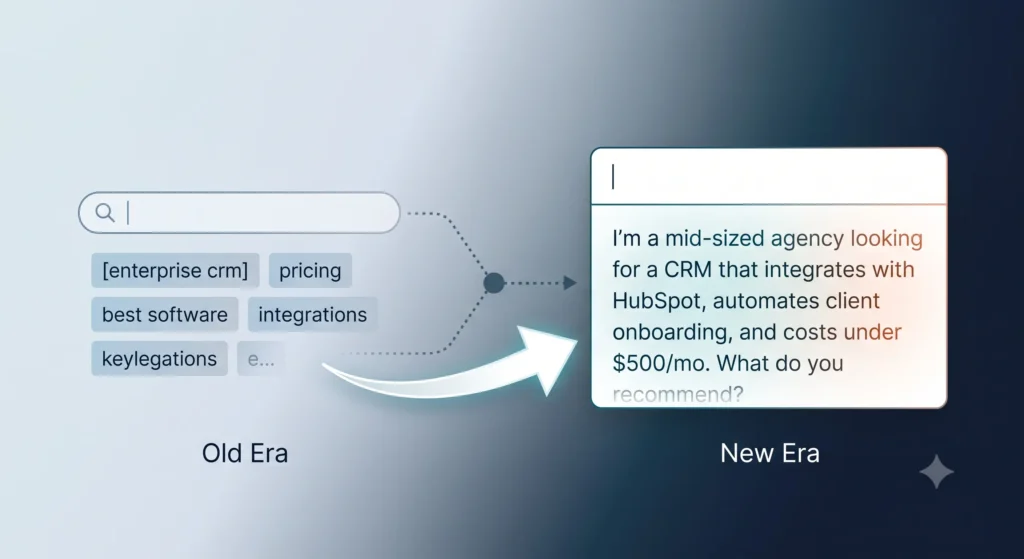
People don’t talk to search bars in short, robotic phrases anymore. Instead of treating search engines like a library catalog, they treat AI tools like a personal assistant.
Nobody types “small business accounting software” when they can just paste:
“I run a 10-person agency. QuickBooks is taking up too much of my week with manual invoicing, and we’re moving away from Stripe. What can I switch to that connects with HubSpot, costs under $300 a month, and is easy to learn?”
That isn’t a keyword. That’s a whole conversation with four different problems packed into a single sentence.
You can’t target a 40-word story with traditional match types. A regular search ad won’t know what to do with that level of detail, and standard ad copy like “Top-Rated Accounting Tool – Free Trial” completely misses the point.
This is the shift from keyword search to prompt-based ads.
The platforms aren’t just matching words anymore; they’re trying to understand the whole situation. Ads are no longer just blue links sitting at the top of a page—they are turning into personalized answers, recommendations, and product cards woven directly into an AI’s response.
If your ad strategy still relies entirely on bidding on isolated phrases, you’re missing out on how people actually discover things today.
Here is what this shift actually means for your daily ad spend, and how you can adapt without throwing out everything you know.
Why Generic Headlines Don’t Work Anymore
For years, we wrote ads like billboard slogans. You had 30 characters for a headline, 90 characters for a description, and a formula that rarely changed:
- Problem: “Tired of High Electric Bills?”
- Solution: “Switch to Solar Today.”
- Call to action: “Get a Free Quote Now.”
That worked when everyone saw the exact same list of ten blue links. But inside an AI conversation, an ad like that sticks out like a sore thumb.
When someone asks an AI a detailed, specific question, a generic sales pitch feels tone-deaf. If the user just explained that their roof is shaded by oak trees and their budget is tight, shouting “#1 Rated Solar Installer!” tells them you didn’t listen.
To win in prompt-based search, your creative has to change in three major ways.
1. Trade Catchphrases for Direct Answers
Your copy can’t just be an invitation to visit your website anymore; it has to be part of the solution right there in the chat.
Instead of writing vague claims like “The Most Flexible Project Tool,” your creative needs to directly address common constraints users tell the AI:
- Old style: “Manage Projects Fast | Free 14-Day Trial | Sign Up”
- Prompt-era style: “Built for 5–20 person agencies migrating off Asana. Direct Slack sync, flat pricing, zero setup fees.”
The goal is simple: when the AI pulls your brand into the conversation, your copy should immediately validate the user’s specific pain point.
2. Feed the Engine Facts, Not Fluff
In the prompt era, the AI often writes or remixes the final ad response using your product data. If your data is vague, your ad will be weak.
Instead of writing dozens of slightly different headline variations, marketers need to feed platforms clean, structured information:
- Clear pricing tiers and what is included
- Exact software integrations
- Delivery turnaround times
- Specific return or cancellation policies
When the AI knows the cold, hard facts about what you sell, it can confidently recommend your product when a user asks: “Show me an option that delivers by Friday and offers free returns.”
3. Move from Static Links to Interactive Cards
The format of the ad itself is changing from a text link to a mini-tool inside the chat.
| Old Ad Units | Prompt-Era Ad Units |
| Single headline + 2 lines of text | Product cards with live pricing and reviews |
| Sitelink extensions | Instant comparison tables against competitors |
| Generic landing page link | In-chat booking buttons, calculators, and carts |
Instead of making people click away to browse your catalog, the ad becomes an interactive snapshot. The user asks the question, the AI suggests your product, and the user can check specs or start checkout without ever leaving the conversation.
The Rule of Thumb
Stop writing ads that try to persuade everyone at once. Start creating structured, helpful information that solves one specific situation at a time. The brands that win won’t be the ones shouting the loudest—they’ll be the ones that give the AI the clearest, most honest answers.
Keyword Ads vs. Prompt Ads: What Actually Changes?
The easiest way to understand this transition is to look at how the daily mechanics of paid search are being rewritten. We aren’t just swapping out a few settings inside an ad account; the fundamental relationship between the user, the platform, and the ad is completely different.
Here is a side-by-side comparison of how traditional search ads compare to prompt-based ads:
| Feature | Traditional Keyword Ads | Prompt-Based Ads |
| How People Search | Short, fragmented phrases (“best accounting software”) | Full, detailed questions with specific context and constraints |
| How Ads Are Matched | Bidding directly on words and match types (exact, phrase, broad) | AI models matching the user’s intent to your product’s features |
| What the Ad Looks Like | A 3-line text box with a blue link and small sitelinks | Direct product recommendations, comparison tables, or interactive cards |
| Where the Ad Appears | At the top or bottom of a list of search results | Woven right into the AI’s conversational response |
| What Marketers Optimize | Bids, Quality Score, negative keyword lists, and ad copy | Clean product feeds, detailed FAQs, and clear factual specifications |
| The User’s Goal | Click a link to go read a website | Get a direct, trustworthy answer without doing extra work |
Three Core Differences You Need to Know
- Intent is spelled out, not guessed: In keyword search, if someone typed “CRM,” you had to guess whether they wanted a job, free templates, or enterprise software. In a prompt, the user tells the model everything up front: their company size, their budget, and their tech stack. There’s far less guesswork about what they want.
- Negative keywords don’t work the same way: You can’t just block the word “cheap” or “free” and call it a day. In a prompt, someone might write, “I need a tool that isn’t cheap and flimsy, but won’t cost an enterprise fortune.” A rigid negative keyword might filter that buyer out, but an AI understanding the context knows they have budget.
- You’re competing on clarity, not hype: Traditional ads often reward clever slogans and high bids. Prompt-based ads favor clarity. If the AI is looking for a solution that fits a user’s exact criteria, the brand that provides transparent pricing and unambiguous feature lists wins the recommendation.
What Your Team Can Do This Week: A Quick Checklist
You don’t need to reinvent your entire marketing stack overnight, but you can take a few practical steps right now to get ahead of the shift:
- Audit your real customer questions: Pull the last 50 support tickets, sales call transcripts, or chat logs. Look for the exact phrasing and multi-part problems customers describe—these are the real prompts people feed AI tools.
- Clean up your product feeds and data: Make sure your specs, pricing, shipping times, and return policies are clearly structured on your site. When AI models look for answers to match against a user’s prompt, they favor clear facts over vague marketing copy.
- Test detailed scenarios in your ad copy: In your responsive search ads, swap out a few generic slogans (“#1 Rated Service”) for constraint-focused copy that mentions team sizes, budget ranges, or specific integration partners.
- Add FAQ and comparison content to key landing pages: Address common “versus” queries and edge-case concerns directly on your pages using clear headings. This helps both search engines and generative models understand who your product is—and isn’t—built for.
- Test chat-based search platforms yourself: Spend 30 minutes prompting tools like ChatGPT, Perplexity, or Google’s AI Overviews with common problems your buyers face. Note which competitors get cited, which products get recommended, and where your brand is completely missing.
How Measurement Changes When Clicks Disappear
In traditional PPC, tracking was straightforward. A user clicked your ad, a cookie fired, they bought something on your site, and your analytics dashboard credited that exact keyword. You put a dollar into the machine and could trace the path straight to the sale.
Prompt-based search breaks that clean line.
When an AI gives someone a detailed answer, the user often gets what they need right there in the chat window. They might see your product recommended, compare it against two competitors, and decide you’re the right choice—without ever clicking a blue link.
Three days later, they open a browser, type your website address directly, and make a purchase.
If you judge that interaction using old last-click rules, your campaign looks like an expensive failure. But in reality, the prompt ad closed the deal.
To evaluate performance without flying blind, you have to track a different set of signals.
1. The Shift in Key Metrics
| Old Metric | What It Measured | The New Metric | What It Actually Tells You |
| Impressions | How many times an ad appeared on a results page | Share of Model / Citation Rate | How often the AI names or sources your brand when people ask relevant questions |
| Click-Through Rate (CTR) | The percentage of people who left search to visit your site | Conversational Engagement | How often users ask follow-up questions about your product, click your in-chat card, or save the result |
| Cost Per Click (CPC) | What you pay each time a person visits your URL | Cost Per Influenced Conversion | The total ad cost divided by the overall sales lift in that product category |
| Last-Click ROAS | Revenue tied strictly to the final URL click | Blended Pipeline Lift | The overall growth in direct traffic, brand searches, and completed orders |
2. The New Ways to Measure Value
- Watch your branded search volume: When AI platforms regularly recommend your product, you’ll see a steady bump in people searching for your exact brand name on traditional engines. That downstream spike is often the clearest proof that your chat visibility is driving sales.
- Track direct and referral traffic spikes: When an AI cites your documentation or recommends your tool, direct visits and untagged direct checkouts climb. Keep an eye on direct traffic trends alongside your prompt campaigns.
- Ask buyers directly: The simplest tool often gets ignored. Put an optional “How did you hear about us?” field on your checkout or signup page, and include options like “ChatGPT / AI Search”. You’ll quickly see how many paying customers found you through conversational tools without ever clicking a trackable ad link.
The Takeaway for Your Budget
If your leadership team insists on measuring prompt ads purely on immediate, last-click tracking, you will underinvest in the channels where your customers are moving.
Treat early prompt placements the way you treat high-impact brand visibility: monitor overall category revenue, measure your brand’s presence in AI answers, and look at the total growth of the business—not just the clicks on a spreadsheet.
Final Words
- Prompts are full conversations, not fragmented keywords: Users are handing AI tools rich context, specific budgets, and clear pain points. Winning ad placements means matching that deep intent, not bidding on isolated two-word phrases.
- Clarity beats clever copy: AI systems recommend solutions based on cold, hard facts. Keep product specifications, pricing, integrations, and policies clean, transparent, and structured.
- Ad formats are becoming interactive: The standard 3-line text box is giving way to native comparison cards, live pricing modules, and in-chat booking tools that answer the prompt on the spot.
- Measurement requires a broader lens: When an AI tool does the heavy lifting, direct clicks drop, but branded searches and downstream conversions rise. Track citation frequency, brand search lift, and blended sales rather than relying entirely on last-click attribution.
The move away from traditional keyword ads isn’t something to fear—it’s a massive upgrade for performance marketers willing to adapt.
For two decades, we had to play an endless guessing game, trying to reverse-engineer what someone actually needed from a fragmented, three-word query. Today, buyers are spelling out their exact problems in plain language. They are telling the platforms precisely what they want, what they can spend, and what won’t work for them.
The winners in this new era won’t be the brands that spend their days micromanaging negative keyword match types or writing the punchiest 30-character headlines. The brands that win will be the ones that provide the clearest information, the most honest answers, and the easiest paths to purchase.
Start building your structured data now, experiment with how conversational search treats your category, and treat this shift for what it is: the best opportunity in twenty years to get in front of buyers at the exact moment they need you.