
For nearly two decades, digital advertising had a simple golden rule: win the keyword, win the customer.
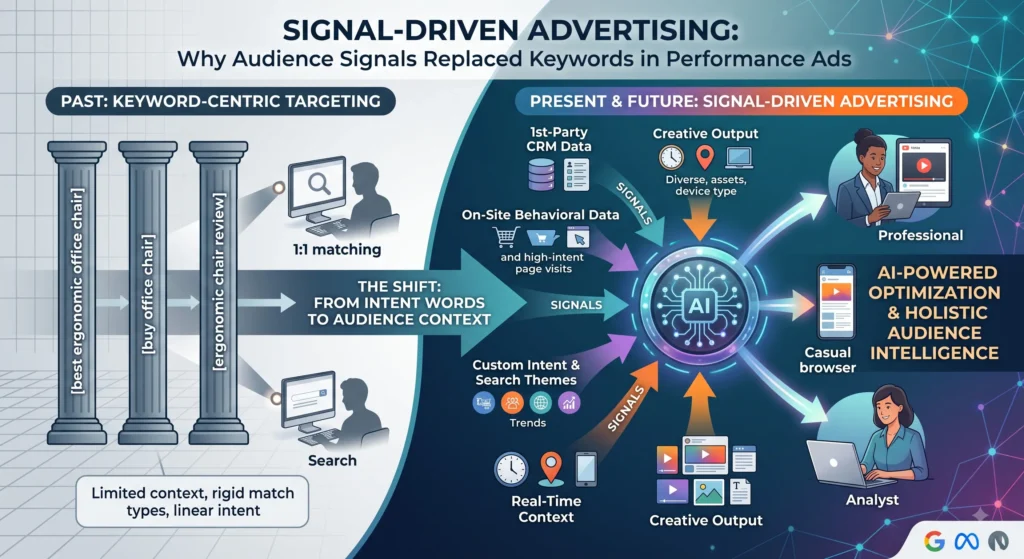
If you sold ergonomic office chairs, you bid on [best ergonomic office chair], built a dedicated landing page, and tracked exact match conversions. But over the last few years, a major shift quietly dismantled this playbook.
Today, automated campaign types across Google and Meta (like Performance Max and Advantage+) don’t rely primarily on exact keyword strings to decide who sees your ad. Instead, modern performance marketing runs on audience signals.
Here is why keywords lost their absolute throne, how audience signals work, and what you need to change to keep driving profitable performance.
The Core Shift: From Intent Words to Holistic Context
Keywords were always a proxy for intent. If someone typed a specific phrase, marketers assumed they knew what that person wanted right at that second.
However, keyword intent is fragile:
- Two different people typing the exact same search query often have completely different budgets, buying urgency, and browsing history.
- Consumer journeys are no longer linear; people bounce across YouTube, Reels, search bars, email newsletters, and marketplaces before buying.
- Exact-match keyword targeting cannot evaluate whether a user is researching for a school project or has a credit card in hand ready to purchase.
Old Approach: Exact Query Match  ──► Ad Shown
New Approach: Query + 1st-Party Data + Real-Time Context ──► Dynamic Ad Delivered
Audience signals provide machine learning models with a holistic profile rather than a static word match. Instead of asking, “Did they type this exact phrase?” algorithms now ask, “Does this person’s broader behavior and profile match our highest-converting customers?”
What Exactly Is an Audience Signal?
An audience signal is any rich data point that helps an advertising algorithm understand who your ideal customer is and where to find more people like them.
Rather than acting as strict targeting boundaries, modern signals serve as steering guides for artificial intelligence.
The Most Powerful Signals Marketers Feed Algorithms Today
| Signal Type | What It Includes | Why It Matters |
| First-Party Customer Data | Customer match lists, past buyer emails, CRM purchase values | Gives the algorithm a precise blueprint of actual paying customers. |
| On-Site & App Behavioral Data | High-intent page visits, cart additions, video completion rates | Highlights users showing active purchase intent in real time. |
| Custom Intent & Search Themes | Themes of interest, high-converting historical search themes | Guides machine learning toward relevant inventory across diverse ad networks. |
| Demographic & Contextual Context | Device, time of day, location, content consumed | Helps the bid engine calculate conversion likelihood dynamically. |
3 Reasons Why Signals Outperform Pure Keyword Targeting
1. Algorithms Need Clues, Not Hard Walls
In older campaign setups, setting tight keyword rules often throttled reach and ignored profitable non-obvious searches. Audience signals give AI models a starting point without trapping them inside narrow constraints. The algorithm uses your signal to test, find conversion clusters, and scale horizontally across placements (Search, Display, Video, Social feeds).
2. Bidding in Real-Time Auction Context
When an ad auction happens, the system evaluates thousands of contextual signals simultaneously:
- Past search history across related topics
- Time elapsed since visiting a competitor’s site
- Current device and network speed
- Estimated lifetime value potential
A keyword cannot communicate any of this. A signal-trained model leverages all of it at the millisecond of the auction.
3. First-Party Data Is Immune to Privacy Deprecations
With third-party cookies declining and privacy regulations tightening, broad third-party tracking lists are losing accuracy. Direct first-party signals—such as verified offline conversions, CRM lifecycle stages, and customer value metrics—are clean, durable, and highly actionable for performance algorithms.
How Performance Marketers Must Adapt Their Playbook
To win in a signal-driven environment, your role shifts from manual rule-maker to strategic data architect.
Old Focus: Negative keyword sculpting & Match-type micromanagement
New Focus: Conversion value hygiene, Creative volume & 1st-party data feeds
- Clean Up Your Conversion Tracking: The algorithm optimizes toward whatever you measure. If you feed it low-intent leads or unverified form fills, it will find more of the same. Prioritize tracking qualified leads and actual revenue.
- Segment Customer Lists by Value: Instead of uploading one massive email list, create tiers: Top 10% highest LTV buyers, repeat customers, and fast-churn segments. Feed your highest-value tiers directly as primary seed signals.
- Treat Creative as the New Targeting: In signal-based environments, your ad creative does the heavy lifting of qualifying the audience. Highly specific copy, clear pricing, and value propositions naturally filter out low-intent clicks.
- Feed Search Themes Instead of Micro-Managing: Provide broad, high-intent themes to guide machine learning rather than endlessly splitting campaigns into dozens of single-keyword ad groups.
Frequently Asked Questions (FAQs)
-
Are keywords completely dead in performance advertising?
No. Keywords still exist, particularly in standard Search campaigns where capturing direct user queries is valuable. However, keywords alone are no longer the primary driver of scale or efficiency. Even in standard search, match types function more broadly and lean heavily on underlying machine learning signals to determine ad delivery.
-
What is the difference between audience targeting and audience signals?
Audience targeting creates a hard boundary—your ad will only show to people on that list or demographic slice. An audience signal acts as a baseline guide—it tells the algorithm to prioritize and learn from that group first, but gives it permission to reach similar high-converting prospects outside the defined list.
-
How large does my first-party customer list need to be to work effectively as a signal?
While most platforms accept lists with a few hundred matched records, machine learning models typically perform best with at least 1,000 to 2,000 active, matched customer profiles. For lower-volume accounts, focusing on high-intent mid-funnel actions (like checkout initiations or engaged page visitors) can supplement smaller buyer lists.
-
How do I know if my audience signals are actually improving performance?
Track your Cost Per Acquisition (CPA) and Return on Ad Spend (ROAS) trends after supplying rich audience inputs, alongside model ramp-up periods. A well-signaled campaign generally exits its learning phase faster, maintains more stable bid efficiency during scaling, and drives higher-quality downstream conversions (such as sales-qualified leads and recurring purchases).