
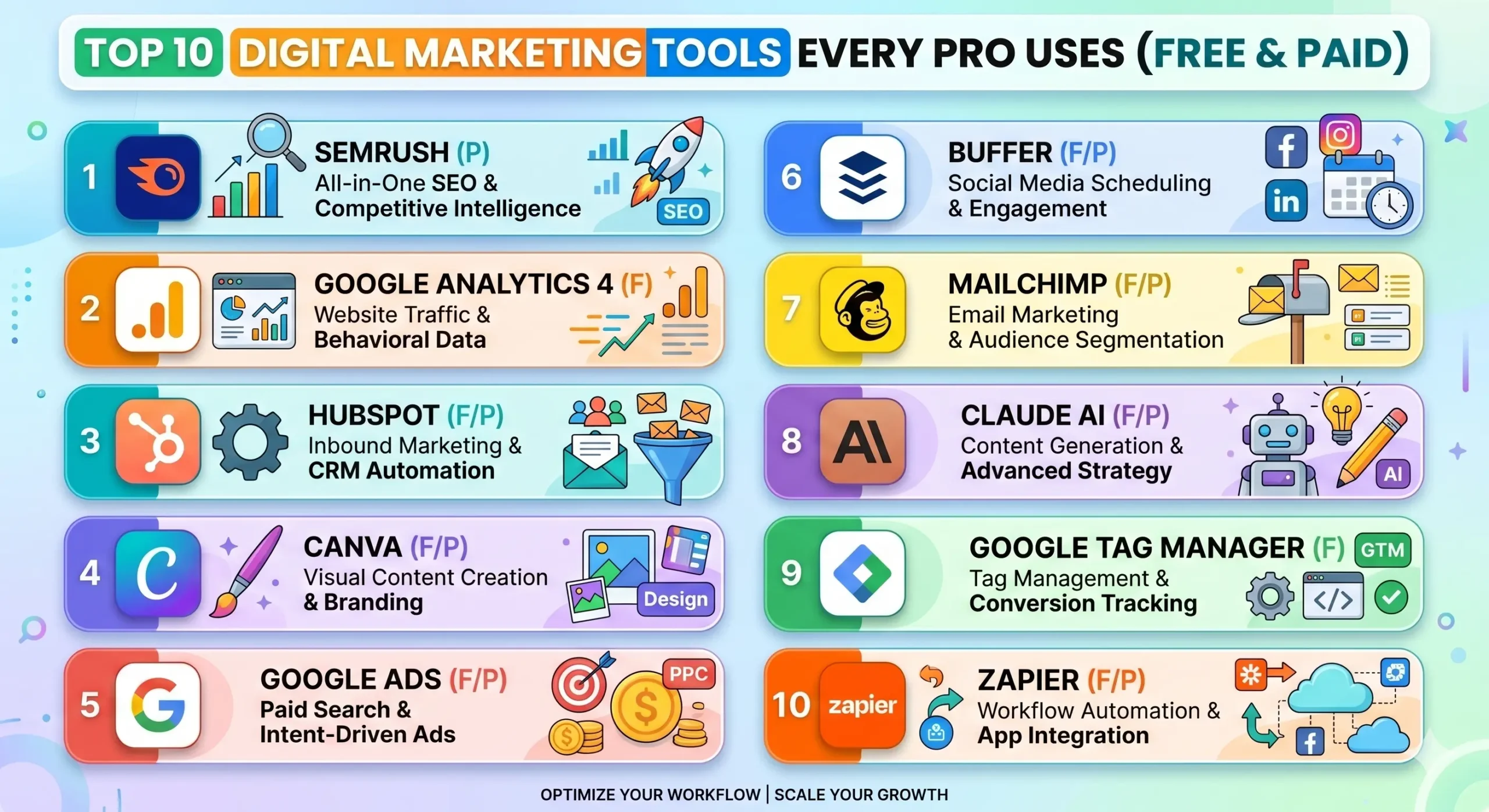
The digital marketing landscape moves fast. What worked a couple of years ago might barely get you noticed today. To stay ahead of the competition, scale your campaigns, and make data-driven decisions, you need the right software in your corner.
Whether you are a freelancer managing your first clients or a seasoned growth marketer at an agency, optimizing your workflow is essential. Here is a breakdown of the top 10 digital marketing tools that marketing professionals rely on every single day, featuring a mix of essential free platforms and high-powered paid solutions.
1. Semrush (Paid with Limited Free Version)
Best For: All-in-One SEO and Competitive Intelligence
Semrush is the Swiss Army knife of digital marketing. From comprehensive keyword research and backlink auditing to tracking your competitors’ paid ad copy, it covers almost every facet of search engine marketing.
- Unique Feature: Keyword Gap Tool. It lets you compare your website directly against up to four competitors to instantly reveal the high-volume search terms they are ranking for that you are completely missing.
2. Google Analytics 4 (Free)
Best For: Website Traffic and Behavior Analytics
If you aren’t tracking your data, you are marketing in the dark. Google Analytics 4 (GA4) is the industry standard for understanding how users find your website and what they do once they arrive.
- Unique Feature: Event-Based Predictive Metrics. GA4 uses machine learning to predict future user behavior, such as purchase probability and churn risk, giving you a chance to optimize campaigns before users walk away.
3. HubSpot Marketing Hub (Free & Paid tiers)
Best For: Inbound Marketing and CRM Automation
HubSpot seamlessly bridges the gap between marketing and sales. It serves as a central hub where you can host landing pages, build automated email workflows, score leads, and track customer interactions from their very first click to their final purchase.
- Unique Feature: Visual Customer Journey Builder. An incredibly intuitive drag-and-drop interface that allows you to map out highly personalized, automated multi-channel marketing campaigns based on exact user actions.
4. Canva (Free & Paid tiers)
Best For: Visual Content Creation and Branding
You don’t need a degree in graphic design to create stunning marketing assets. Canva enables teams to rapidly produce social media graphics, presentation decks, videos, and display ads using thousands of customizable templates.
- Unique Feature: Magic Studio. Canva’s built-in AI suite that allows you to instantly resize a single design across multiple social platforms, translate text within graphics into dozens of languages, and remove backgrounds with one click.
5. Google Ads (Free Tool / Pay-Per-Click)
Best For: Paid Search and Intent-Driven Advertising
When users want to buy something, they search for it on Google. Google Ads allows you to place your product or service right at the top of those search results exactly when a potential customer is looking for what you sell.
- Unique Feature: Google Keyword Planner. Located right inside the platform, this free tool gives you access to precise search volume data, competition levels, and cost-per-click estimates straight from the source.
6. Buffer (Free & Paid tiers)
Best For: Social Media Scheduling and Engagement
Managing multiple social media profiles can easily eat up your entire week. Buffer simplifies the process by letting you schedule posts, analyze performance, and engage with your community across LinkedIn, Instagram, TikTok, and X from a single dashboard.
- Unique Feature: Buffer AI Assistant. An integrated text generator that helps you brainstorm post ideas, repurpose a single piece of copy into different tones for different networks, or instantly shorten long articles into snappy social updates.
7. Mailchimp (Free & Paid tiers)
Best For: Email Marketing and Audience Segmentation
Email marketing still delivers some of the highest ROI in the industry. Mailchimp has evolved from a basic newsletter sender into a sophisticated automation tool that handles transactional emails, behavioral targeting, and complex drip campaigns.
- Unique Feature: Content Optimizer. An AI-driven feature that analyzes your email campaigns against millions of top-performing emails in your industry, offering specific, data-backed suggestions to improve your copy, layout, and imagery.
8. Claude AI (Free & Paid tiers)
Best For: Content Generation and Advanced Strategy
Artificial intelligence has completely changed how content teams scale. While many rely on basic generative tools, Claude by Anthropic stands out for marketers who need nuanced, long-form content writing, deep strategic analysis, and complex prompt execution.
- Unique Feature: Projects & Artifacts Context Window. It allows you to upload entire brand guidelines, past style guides, and product documentation into a dedicated workspace so every blog post, ad copy, or email draft generated is perfectly aligned with your unique brand voice.
9. Google Tag Manager (Free)
Best For: Tag Management and Conversion Tracking
Deploying tracking scripts like Meta Pixels, Google Ads tags, or heatmaps directly onto a website can easily slow down your load times and break your site’s code. Google Tag Manager (GTM) solves this by acting as a single container that manages all your scripts without requiring you to touch your core HTML.
- Unique Feature: Preview and Debug Mode. This tool lets you test exactly how your tracking tags fire in real-time on your live site before deploying them, preventing broken conversion data.
10. Zapier (Free & Paid tiers)
Best For: Workflow Automation and App Integration
A digital marketer’s stack can get messy fast. Zapier acts as the digital glue that connects your apps together, allowing you to build automated workflows (called “Zaps”) without writing a single line of code.
- Unique Feature: Multi-Step AI Zaps. You can set up a trigger where a new lead from a Facebook Ad automatically gets sent to Claude to write a personalized introductory email, saves the contact info into your HubSpot CRM, and alerts your team on Slack simultaneously.
Finding Your Perfect Digital Marketing Tools
There is no one-size-fits-all solution when building your marketing toolkit. If your primary focus is organic growth, prioritizing tools like Semrush and Google Analytics 4 will yield the highest returns. If you are looking to scale customer acquisition quickly, a combination of Google Ads, HubSpot, and Zapier will keep your pipeline running smoothly.
Start out by experimenting with the free tiers of these platforms to see how they fit into your day-to-day workflow. Once you see the impact they have on your efficiency and campaign ROI, scaling up to the premium features becomes an easy business decision.
Which tool is already a permanent fixture on your browser tabs? Let us know in the comments below!