
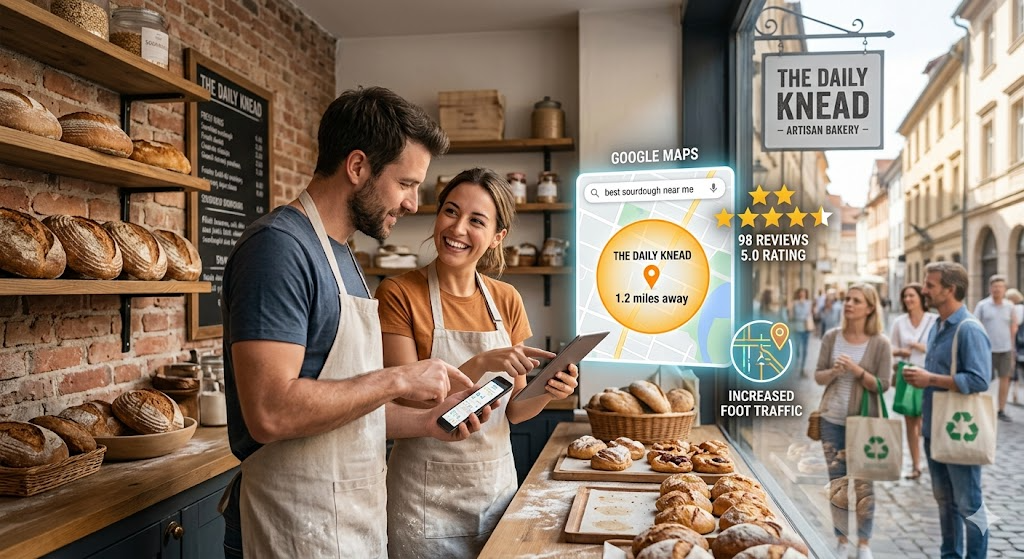
Imagine you are walking down a street in a Jaipur and suddenly crave a cheese sandwich. What’s the first thing you do? You pull out your phone, open Google and type “best cheese sandwich near me” or “sandwich shops in Jaipur”
In seconds, Google provides a map, a list of three top-rated shops, their opening hours, and photos of their latest batches. Those three shops didn’t appear there by accident. They are there because of Local SEO.
For small business owners, Local SEO is no longer just an item in the checklist, it is the digital store that determines whether customers find you or your competitor down the street.
What Exactly Is Local SEO?
Local SEO (Search Engine Optimization) is the process of optimizing your online presence to attract more business from relevant local searches. While standard SEO focuses on ranking a website globally or nationally, Local SEO focuses on appearing in the google map results and localized organic results on SERP.
This has evolved gradually. It’s not just about keywords, it’s about trust, proximity, and relevance. Search engines now use AI to analyze your reviews, your location data, and even the photos you post to decide if you are the best answer to a user’s “near me” query.
Why Local SEO Matters for Small Businesses
Importance of local SEO for small businesses and shop owners are because of:
1. High-Intent Traffic
When someone searches for a local service, they aren’t just “window shopping.” Statistics show that 72% of consumers who perform a local search visit a store within five miles. Local SEO connects you with people who have their wallets out and are ready to buy.
2. The Rise of AI and Voice Search
With the integration of AI-driven search (like Google’s AI Overviews), customers often get their answers without even clicking a website. If your Local SEO is strong, AI tools will recommend your business as the “trusted local expert,” citing your positive reviews and clear service descriptions.
3. Leveling the Playing Field
Small businesses often can’t spend more than national corporations on global ads. However, Local SEO allows you to win in your own city. Google prioritizes proximity, if you are two blocks away and have great local signals, you can outrank a billion-dollar brand located ten miles away.
Which Businesses Perform Best On Local Searches?
Google Business Profile (GBP) and local rankings work best for businesses driven by proximity, immediacy, and physical presence, capturing high-intent users exactly when they are ready to buy.
The types of businesses that benefit the most include:
- Urgent Services: Plumbers, electricians, and towing companies. Customers in a crisis pick the top-rated results in the Map Pack immediately.
- Brick-and-Mortar Retail & Dining: Restaurants, cafes, and local shops. High review scores and updated hours directly drive instant foot traffic.
- Medical & Professional Services: Dental clinics, law firms, and real estate agencies. Local prominence builds the geographic trust needed to capture regional clients.
- Wellness & Hospitality: Salons, gyms, and hotels. These thrive by showcasing active listings with consistent photos and customer reviews.
Apart from the above listed businesses, small shops like cosmetics, bootiques, salon, pest control etc also fall under local business category.
Create Local SEO Strategy & Optimization Checklist
To get your business on the map, you need to focus on these four essential areas:
1. Create and Optimize Your Google Business Profile (GBP)
Your Google Business Profile is your most important local asset. It’s the profile that feeds information to Google Maps.
- Keep it Updated: Ensure your business name, category, description, service/products (with images), hours, phone number, and address are 100% accurate. You can also add service areas list and add a website link.
- Post Regularly: Treat your GBP like a social media feed. Post updates about new products, seasonal offers, or behind-the-scenes photos. Give link to your website if you have any. Apart from updates, add images on your profile.
- Keywords in Description: Naturally include your city name and primary services in your business bio.
2. Consistency is King: NAP Data
NAP stands for Name, Address, and Phone number. Google’s AI bots crawl the web to see if your information is consistent. If your address is listed as “123 Main St” on your website but “123 Main Street” on Yelp, it can create a “trust gap” that hurts your ranking. Ensure your NAP data is identical across all directories.
3. The Power of Online Reviews
Search engines don’t just look at how many reviews you have, but the sentiment within them.
- Keywords in Reviews: When a customer says, “The best gluten-free pizza in Austin,” it acts as a massive SEO boost. Do not ask the customers to put these kind of keywords forcefully in the reviews, always let them put up a message naturally. Make sure any personal information like names or numbers are not added in the reviews. Google removes and flags them.
- Respond to Everyone: This is important. Whether the review is five stars or one star, responding shows Google that you are an active, engaged business. This is actually the most important part of GBP optimization. Doing it consistently improves visibility and rankings.
4. Localized Content
Your website shouldn’t just talk about what you do, it should talk about where you do it.
- Create location-specific landing pages if you serve multiple neighborhoods.
- Write blog posts about local events, partnerships with other local shops, or “best of” guides for your city. This signals to search engines that you are a pillar of the local community. These posts can also be prmoted on GBP updates section.
3 Quick Tips to Start Today
- Claim Your Listings: Beyond Google, make sure you exist on Apple Maps, Yelp, and Bing Places.
- Go Mobile-First: Most local searches happen on the go. If your website takes more than three seconds to load on a phone, you’ve already lost the customer. Hence, work on technical SEO of your site.
- Use Real Photos: Stock photos are out. High-quality, original photos of your team and your office build the authenticity that AI search engines now prioritize.
Final Thoughts
Local SEO isn’t a “one-and-done” task, it’s a marathon. However, for a small business, it is the single most effective way to ensure that when a neighbor looks for help, they find you.
2 thoughts on “What Is Local SEO and Why It Matters for Small Businesses in 2026”