
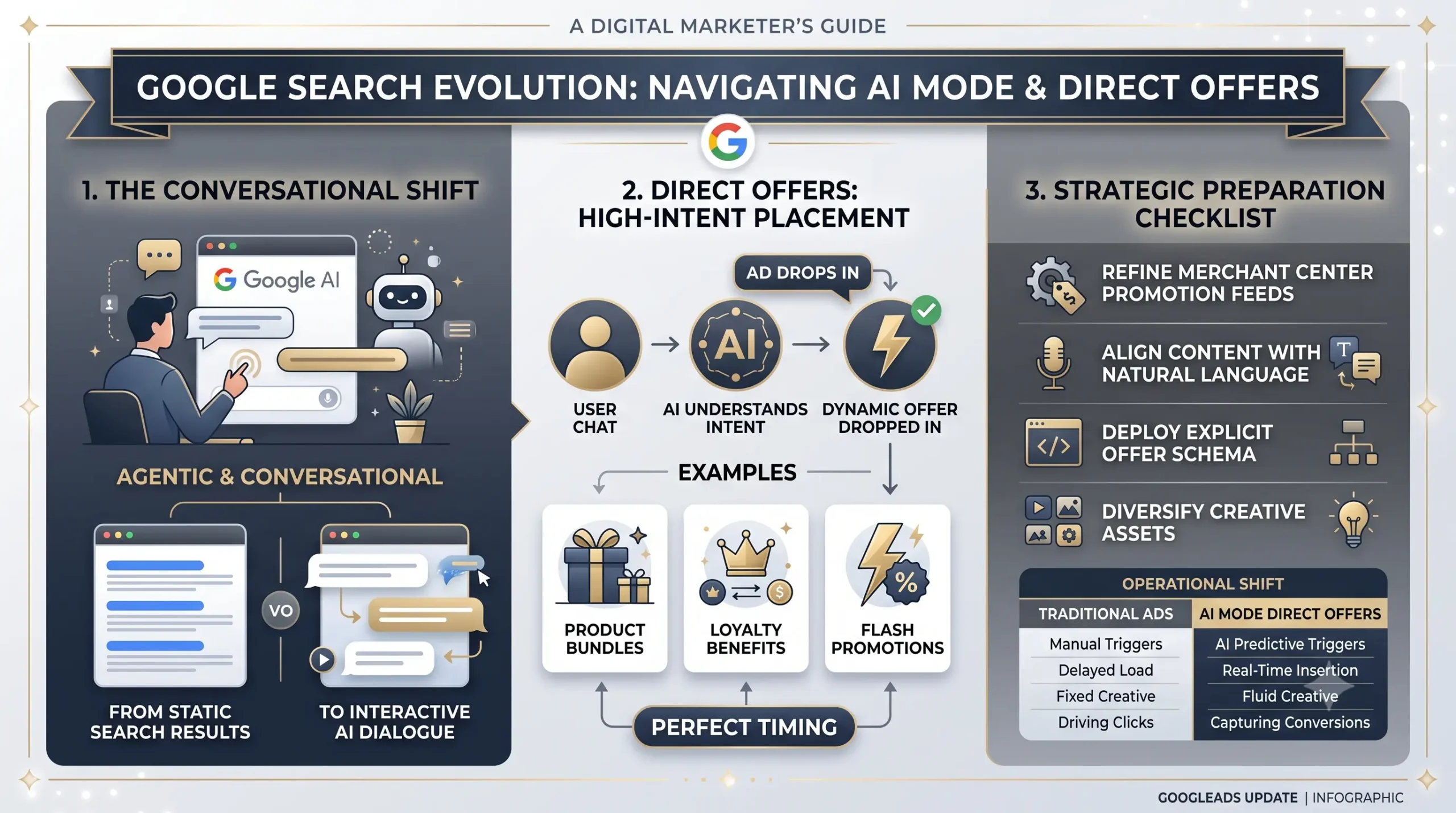
The traditional search engine results page is shifting from a static list of blue links into an interactive, conversational ecosystem. With the expansion of AI Overviews and the rollout of a fully conversational AI Mode, users are no longer just searching—they are consulting an AI agent.
To keep pace with this behavioral change, Google has fundamentally updated its advertising infrastructure. Ad delivery is moving away from basic text matching toward real-time transactional placement embedded directly within generative responses.
For retail brands and digital marketers, visibility in this new landscape requires a complete pivot in how promotional assets are built and deployed.
What are Direct Offers in AI Mode?
Direct Offers are highly dynamic, contextually driven ad units natively injected into Google’s conversational AI interface. Instead of appearing as a standard sponsored banner on the side of the screen, these ads drop smoothly into the generative dialogue.
The system evaluates the exact trajectory of a user’s conversation to serve highly tailored incentives. These include:
- Product Bundles: Automatically pairing complementary items based on the specific problem the user is discussing with the AI.
- Loyalty Benefits: Dynamically offering instant rewards, points, or exclusive sign-up perks mid-chat.
- Flash Promotions: Dropping hyper-targeted discounts right when the user displays immediate transactional intent.
The Mechanics of Mid-Conversation Ad Triggers
Understanding exactly when and why these ads appear is crucial for optimizing your campaign assets. Google’s machine learning engine maps user intent continuously throughout a single chat session.
| Ad Component | Traditional Search Ads | AI Mode Direct Offers |
| Trigger Mechanism | Static keyword queries | Predictive conversational intent signals |
| Ad Delivery Timing | Immediate load upon initial search | Real-time insertion at the exact point of decision |
| Creative Structure | Fixed headlines and descriptions | Fluid promotions tailored to chat context |
| User Experience | Disruptive, standard text blocks | Native, organic additions to an AI answer |
| Primary Goal | Drive top-of-funnel clicks | Capture bottom-of-funnel conversions |
Strategic Advantages of Conversational Commercial Placements
Integrating your promotional strategy with AI Mode changes the dynamic between your brand and potential buyers.
- Perfect Timing Optimization: Ads appear at the exact millisecond a high-intent user prepares to finalize a buying decision, minimizing friction.
- Deep Contextual Relevance: Because the generative engine evaluates the entire conversation string, the offer feels like a helpful recommendation rather than an interruption.
- Higher Conversion Efficiency: Bypassing standard click funnels by providing immediate value within the search interface naturally drives stronger return on ad spend (ROAS).
Action Plan to Prepare for AI Mode
To ensure your brand is selected for Direct Offers, your product feeds and asset libraries must be structured for rapid machine extraction.
- Refine Merchant Center Promotion Feeds: Keep your coupon codes, bundle details, and bulk discounts meticulously updated so the AI engine can pull clean data instantly.
- Align Content with Natural Language: Structure your landing page text and product data descriptions to match the conversational style of voice and chat queries.
- Deploy Explicit Offer Schema: Use advanced JSON-LD structured data on your website to explicitly define price, availability, and specific deal structures for AI scrapers.
- Diversify Creative Assets: Supply Google’s asset groups with varied text summaries, clear pricing visuals, and bundle variations to give the generative engine maximum flexibility.
For a closer look at ensuring your technical architecture remains highly crawlable for these advanced search scrapers, review the Google Search Central Documentation to audit your underlying code layouts.
Summary
The launch of Direct Offers within Google’s conversational AI Mode marks a permanent shift toward agentic, real-time digital commerce. Winning in this landscape means moving past static text copy and preparing highly flexible, context-rich promotional data feeds. By optimizing your product data infrastructure today, you ensure your brand lands the definitive closing spot right when consumers are ready to buy.
Frequently Asked Questions (FAQs)
Q1: Will AI Mode and Direct Offers also impact my standard Responsive Search Ads (RSAs)?
A: No, Direct Offers will not replace your RSAs. Traditional keyword-based search setups will continue to capture standard browser traffic, while Direct Offers function as an entirely separate, conversational ad format designed to capitalize on agentic chat sessions inside Google’s AI interface.
Q2: How does Google decide which brand gets the Direct Offer spot in a conversation?
A: The algorithm selects offers based on deep semantic matching, real-time intent processing, and structural trust signals. It heavily prioritizes websites that feature clear structure, flawless schema markup, and highly relevant merchant promotional data that directly solves the user’s explicit query.
Q3: Can small e-commerce brands participate in Direct Offers, or is it restricted to large enterprise retailers?
A: Any advertiser utilizing automated merchant feeds can potentially trigger Direct Offers. Because the system relies heavily on automated indexing and immediate contextual relevance rather than just massive budget scales, smaller brands with clean data frameworks and competitive promotions stand a strong chance of winning conversational real estate.
Q4: What happens if my product data feed contains broken links or outdated promotional codes?
A: Outdated data will immediately disqualify your ads. The machine learning engine behind AI Mode requires absolute data precision to protect the user experience; if the algorithm detects conflicting information or invalid destination URLs, it will instantly pass over your assets in favor of a compliant competitor.