
If you’ve noticed that your Google search results look completely different lately, you aren’t alone. The days of clicking through a list of ten blue links are fading. Instead, AI-generated summaries are taking over the top of the search results page.
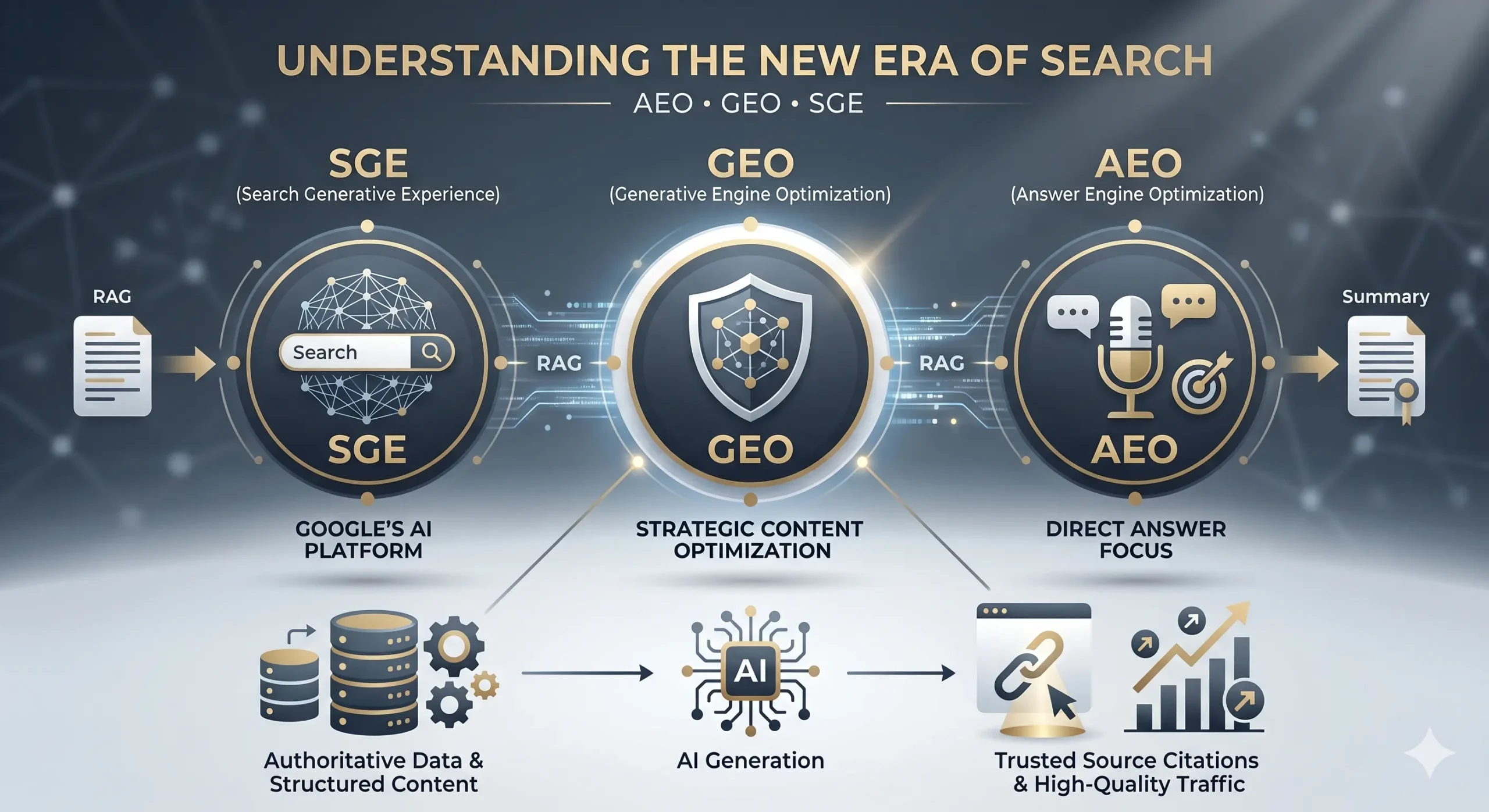
This shift has introduced a wave of new industry acronyms: SGE, AEO, and GEO.
While many tech blogs skip over the basics because they think “everyone knows this by now,” the truth is these three concepts are frequently mixed up. Understanding exactly how they differ and how they work is the only way to keep your website visible in the age of AI.
Let’s break down what AEO, GEO, and SGE actually mean, how they operate under the hood, and how they impact the future of the internet.
Defining the Acronyms: SGE, AEO, and GEO
To understand the big picture, we first need to define the individual pieces of this AI search puzzle.
1. What is SGE (Search Generative Experience)?
SGE was the internal project name for Google’s initiative to embed generative AI directly into its search engine. Today, you see this live in standard search results as AI Overviews. Instead of just pointing you to websites, Google uses its Gemini AI model to read the web for you, synthesize the data, and write a custom answer right at the top of the page.
2. What is AEO (Answer Engine Optimization)?
AEO is a specific optimization strategy. It is the practice of structuring your website’s content so that “answer engines” (like Alexa, Siri, ChatGPT, or Google Gemini) can easily pull your data to answer voice commands or conversational questions.
3. What is GEO (Generative Engine Optimization)?
GEO is the broader, modern evolution of SEO. It is the process of optimizing your entire digital footprint so that generative AI search engines cite your website as a trusted source inside their AI-generated summaries.
How Are They Different? (The Nuance Most People Skip)
It is easy to think these three things are the same, but they represent entirely different parts of the search ecosystem: The Platform, The Philosophy, and The Tactic.
| Concept | What It Is | Who Controls It | The Core Goal |
| SGE (AI Overviews) | The Platform/Feature | To give users instant answers without making them click links. | |
| AEO | The Philosophy | You (The Creator) | Optimizing for direct, single-answer queries (often voice search). |
| GEO | The Tactical Strategy | You (The Creator) | Optimizing content to be cited as a source inside complex AI summaries. |
The Obvious Missing Piece: Standard SEO optimizes for algorithms to rank your page #1. GEO optimizes for LLMs (Large Language Models) to summarize your page and include it as a source chip or citation link within the AI answer box.
How AI Search Works Behind the Scenes
When you type a prompt into an AI-powered search engine, the process is vastly different from traditional keyword matching. It generally follows a three-step cycle:
Step 1: Retrieval-Augmented Generation (RAG)
The AI doesn’t just guess the answer based on its past training. It performs a real-time search of the live internet to find the most relevant, up-to-date web pages tracking your query.
Step 2: Synthesis and Fact-Checking
The LLM reads the top retrieved pages, cross-references facts to ensure accuracy, and discards fluff.
Step 3: Generation and Citation
The AI writes a conversational response. Crucially, it attaches links and citations (often called “source chips”) to the sentences it generated, proving where it got the information. This is where you want your website to appear.
The Real Impact on Creators and Businesses
The rise of GEO and AI Overviews is causing a massive shift in how web traffic flows.
1. The “Zero-Click” Dilemma
Because Google now answers complex questions directly on the search page, users don’t need to click through to websites as often. Information-based sites (like simple encyclopedias or basic definition blogs) are seeing a drop in organic traffic.
2. Traffic Becomes Lower in Volume, Higher in Quality
While total clicks might go down, the users who do click through your citation links are highly motivated. They’ve already read the AI summary, decided they need more depth, and clicked your link to get it.
3. Brand Authority is the New PageRank
AI models prioritize content that exhibits high E-E-A-T (Experience, Expertise, Authoritativeness, and Trustworthiness). If your brand is frequently mentioned across the web alongside specific topics, AI engines will naturally trust and cite you more.
How to Optimize Your Content for GEO
If you want your website to be featured in AI Overviews, you need to optimize your content style. Traditional keyword stuffing will actively hurt you. Instead, focus on these hidden optimization pillars:
- Use the “Inverted Pyramid” Writing Style: Put your direct, clear answer in the very first paragraph of your article. AI engines want to grab the answer quickly; don’t make them dig through 500 words of intro text.
- Include Uncopyable Data: AI can summarize generic facts easily. It cannot replicate your unique case studies, original data, quotes from interviews, or hands-on photos. Focus heavily on creating original, primary-source content.
- Structure with Clear Schema Markup: Use technical schema (like Product, FAQ, or Organization schema) to help the AI engine understand the exact context of your data without misinterpreting it.
- Optimize for Conversational Keywords: People don’t search “best laptop 2026” in AI engines; they type “I am a college student on a budget, what laptop should I buy for video editing?” Write content that speaks directly to these long-tail, situational prompts.
Summary: A Quick Cheat Sheet
- SGE/AI Overviews is Google’s AI-powered search results layout.
- AEO focuses on providing quick, direct answers for voice and virtual assistants.
- GEO is the new playbook for optimizing your website to get cited inside AI-generated search results.
- The Impact: Traditional organic search clicks are shrinking, making high-quality, authoritative, and deeply original content more critical than ever for survival.
To dive deeper into adapting your digital strategy, you can read Google’s Official Guidelines on AI Content and explore the latest industry experiments on the V7 Labs Guide to RAG.