
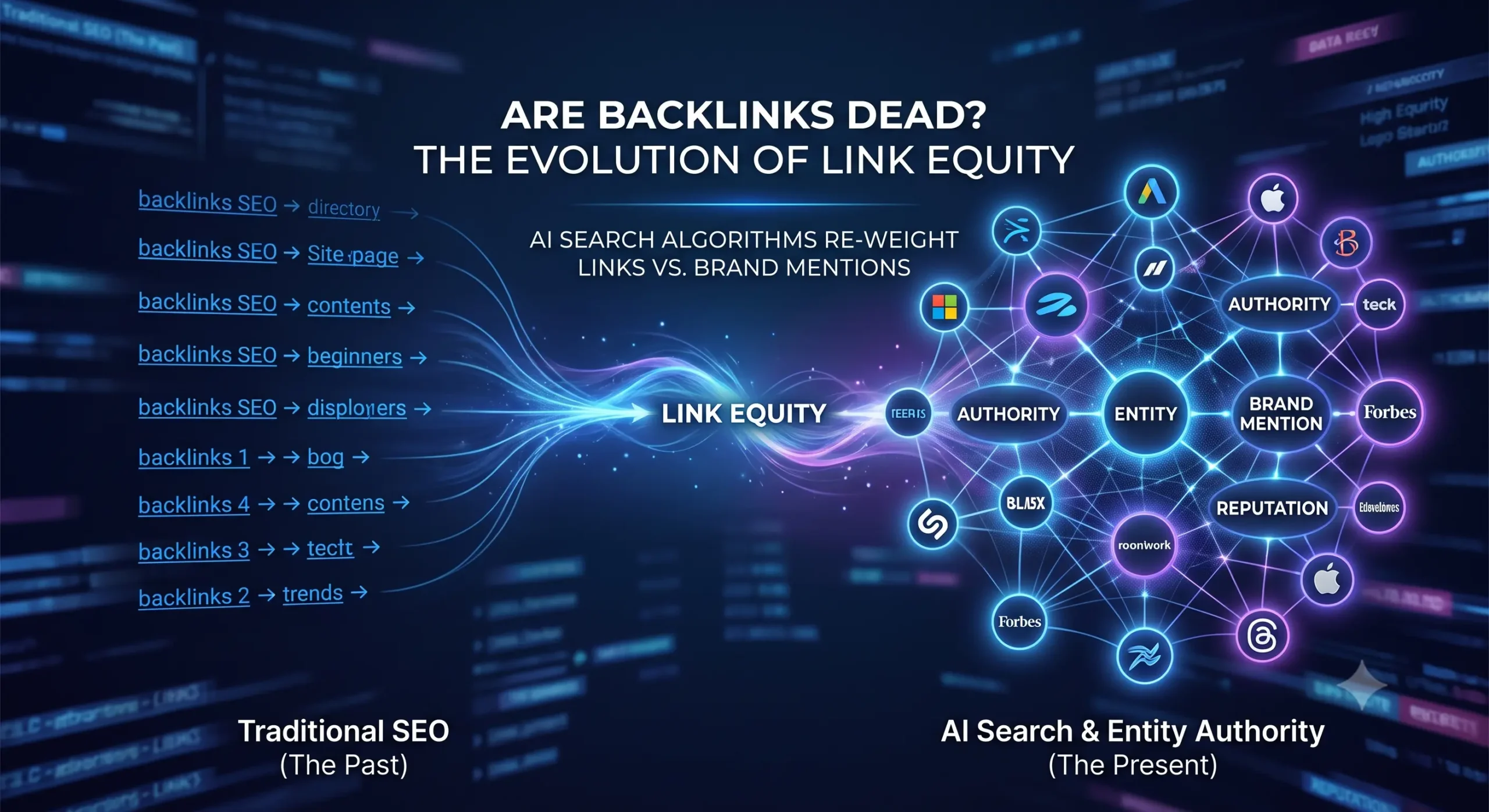
For nearly three decades, the rule of SEO was simple: more links equal higher rankings.
If you wanted to rank for “best project management software,” you built a spreadsheet, reached out to hundreds of blogs, and secured as many hyperlinked anchors as humanly possible. Search engines treated those blue underlines as literal votes of confidence.
Then came AI search engines.
With the rise of large language models (LLMs) powering search results, a quiet shift occurred. Marketers started asking: Are backlinks dead?
The short answer is no, but the game has completely changed.
Here is how AI search algorithms re-weighted the value of traditional backlinks versus unlinked brand mentions, and why your SEO strategy needs to pivot from link hunting to reputation building.
From PageRank to Contextual Vectors
To understand where we are, we have to look at how search used to work.
Traditional search engines relied heavily on PageRank. They treated the web like a web of physical roads. A link from Site A to Site B was a direct highway pass. The more highways leading to your site—and the bigger the authority of those highways—the higher you ranked.
AI search models do not just count highways. They read the whole map at once.
Instead of relying strictly on anchor text and hyperlinked paths, modern algorithms rely on vector embeddings and contextual co-occurrence. They read vast amounts of unstructured text across the web and build connections between entities (brands, people, products, and concepts).
The Death of the “Link Farm”
Because AI models understand context, the old tricks no longer work.
In the past, you could buy a backlink on a low-quality guest post site that covered everything from plumbing in Ohio to crypto trading in Dubai. As long as the site had a decent domain authority score, that backlink passed equity to your site.
Today, an irrelevant backlink carries near-zero weight in AI search.
Why? Because an LLM analyzes the entire page’s semantic meaning. If a site discussing “top interior design trends” suddenly drops a hyperlinked phrase for “best cloud hosting platform,” the AI flags it as artificial manipulation. The context does not match, so the link equity vanishes.
Also Read: Designing Landing Pages for B2B vs. B2C: The Anatomy of a High-Converting Page
The Rise of the Unlinked Brand Mention
Here is where things get interesting for modern marketers.
Suppose Forbes writes an article analyzing top financial tech startups. They mention your brand name, discuss your product features, and quote your CEO—but they do not include a hyperlink back to your website.
In 2015, SEOs would have emailed the editor begging for a link. In the era of AI search, that unlinked mention is already doing heavy lifting.
Why Unlinked Mentions Matter to AI
- Entity Association: LLMs train on vast datasets to learn which entities belong together. When your brand name consistently appears alongside terms like “reliable,” “market leader,” or specific industry keywords, the model learns that your brand is an authority in that space.
- Contextual Co-occurrence: If high-trust sources mention your brand in relevant discussions, the AI registers your presence even without a physical blue link to crawl.
- Natural Consensus: Unlinked mentions are harder to fake at scale through traditional link-spam tactics, making them a cleaner signal of genuine popularity.
A Real-World Example: SaaS Brand A vs. SaaS Brand B
To see how this plays out in real search results, consider two fictional project management tools:
- Brand A (The Link Hunter): They spent $10,000 buying 150 backlinks from generic tech blogs and directory sites. Every link uses the exact anchor text “best task management app.”
- Brand B (The Reputation Builder): They spent their budget on PR, podcasts, and community building. They secured 20 unlinked mentions in major industry publications, got discussed on Reddit forums, and were cited in three expert roundup posts.
The Result in AI Search:
When a user asks an AI search engine for task management recommendations, the AI evaluates semantic consensus across trusted web entities.
- Brand A gets filtered out because its backlink profile looks artificial and disconnected from genuine user discussions.
- Brand B gets featured in the AI summary because the model recognizes its entity name frequently appearing in authentic, authoritative conversations about project management.
How to Shift Your Strategy: From “Link Hunting” to “Reputation Building”
If links are secondary to contextual trust, how should your team adjust its strategy?
1. Focus on Digital PR Over Outreach Cold-Calls
Stop sending mass emails asking for link swaps. Instead, focus on story-driven digital PR. Pitch original research, expert commentary, or unique data insights that journalists and industry blogs want to cite.
2. Monitor and Claim Brand Equity
Track where your brand is being talked about online using social listening and brand monitoring tools. If a major publication mentions your brand without a link, celebrate—it is already helping your AI search presence. (Though asking politely for a link still doesn’t hurt for driving direct referral traffic!)
3. Build Entity Authority Across Platforms
AI search engines pull data from everywhere—Reddit discussions, YouTube transcripts, podcast notes, and review platforms. Ensure your brand name, core products, and key executives are consistently named across all these platforms.
The Verdict
Backlinks are not dead, but their role has been re-contextualized. A high-quality link from a relevant site remains a powerful signal. But a link is no longer the only currency that matters.
In the AI search era, reputation is the new link equity. Focus on being talked about in the right places, by the right people, in the right context—and the search algorithms will take care of the rest.
Frequently Asked Questions
Q: Are traditional backlinks still worth building?
Yes, but only if they come from contextually relevant, authoritative sites in your industry. Quality and semantic relevance have completely replaced sheer link volume.
Q: How do AI search engines discover unlinked brand mentions?
LLMs process and tokenize unstructured text across the web. Instead of following physical HTML hyperlinks, they analyze text patterns to identify relationships between your brand name, key topics, and trust signals.
Q: Should I still ask websites to add a link to an unlinked mention?
Yes. While the unlinked mention already helps your brand’s entity authority in AI search, a working hyperlink still provides immediate referral traffic and traditional crawl paths.
Focus on digital PR, publishing original research or data, appearing on industry podcasts, and maintaining an active, consistent brand presence across platforms like Reddit, YouTube, and top trade publications.