
A user clicks your ad, lands on your page, and makes a decision in less than three seconds.
Are they staying, or are they bouncing?
While B2B and B2C landing pages share the same basic goal—getting the visitor to take action—they play by completely different rules.
A B2B purchase often involves a big budget, a long decision process, and multiple stakeholders. A B2C purchase is usually quick, personal, and driven by immediate emotion or need.
If you treat a B2B visitor like a B2C shopper (or vice versa), your conversion rates will suffer.
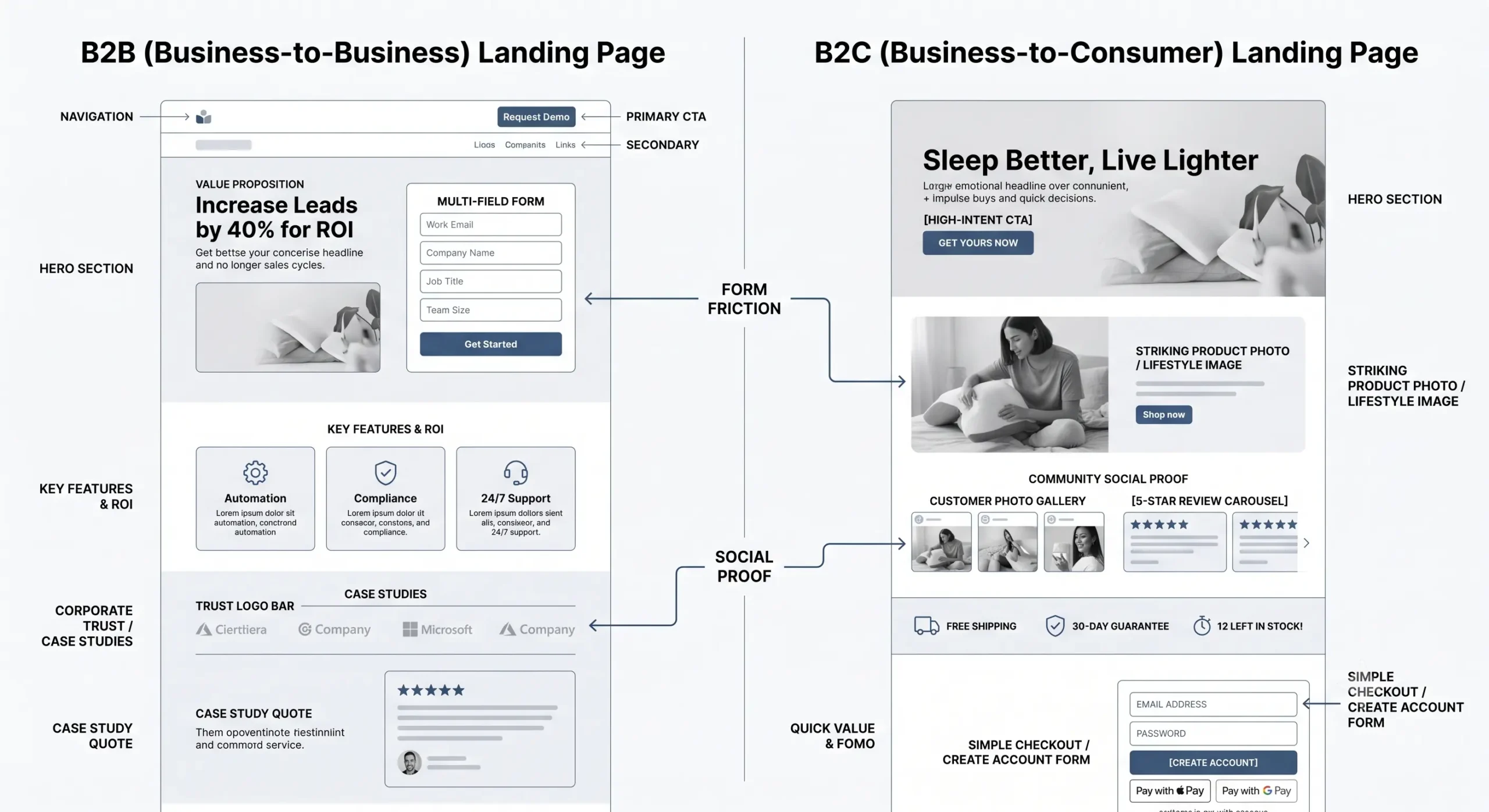
Here is a side-by-side breakdown of how to build landing page elements for both worlds.
1. The Hero Section: First Impressions
Your hero section sits right at the top of the page. It sets the tone immediately.
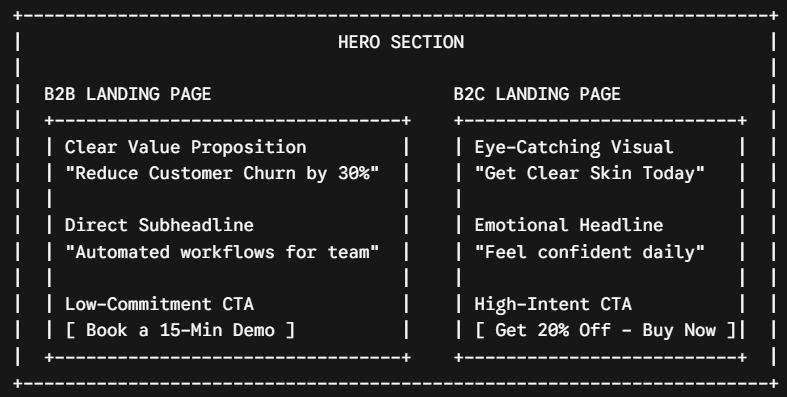
B2B: Clarity Over Cleverness
In B2B, the headline must explain what problem you solve and for whom. Business buyers do not want vague, poetic phrases. They want efficiency, ROI, and reliability.
- Headline Goal: State the core business benefit clearly.
- Example: “Automate Your Monthly Financial Audits and Save 20+ Hours per Week.”
- Visual Focus: Product interface screenshots, clean dashboard views, or workflow diagrams.
B2C: Emotion and Instant Gratification
In B2C, your hero section needs to create an immediate feeling or desire. You are selling a outcome, a lifestyle, or a quick fix.
- Headline Goal: Tap into desire, comfort, or curiosity.
- Example: “Sleep Like You’re on Vacation Every Single Night.”
- Visual Focus: High-resolution product photography, lifestyle shots, or short video loops showing the product in action.
2. Lead Capture Forms: Friction vs. Speed
How much information should you ask for? It depends entirely on the buyer journey.
| Feature | B2B Landing Pages | B2C Landing Pages |
| Form Fields | 4–7 fields (Work Email, Company Name, Job Title, Team Size) | 1–2 fields (Email or Phone Number, or direct Checkout) |
| Friction Level | Intentional friction to filter out unqualified leads | Minimal friction to speed up impulsive buying |
| Primary Goal | Lead qualification for sales follow-up | Immediate transaction or subscription |
| Verification | Often blocks personal domains (@gmail.com) | Accepts any valid contact info |
The B2B Approach
B2B sales teams do not want hundreds of useless leads. They want qualified leads. Adding fields like “Company Size” or “Current Software” helps sales reps prioritize who to contact first.
The B2C Approach
Every extra field on a B2C form drops conversions significantly. If you are selling sneakers or a software subscription, keep it simple: Email, Password, Pay.
3. Social Proof: Building Trust Differently
Social proof proves that other people trust you. But business buyers and everyday consumers look for different types of validation.
B2B Social Proof: Authority and Validation
B2B buyers risk their professional reputation if they pick a bad vendor. They need reassurance that established companies trust you.
- Logo Bar: High-profile client logos (“Trusted by Fortune 500 teams”).
- Case Studies: Real data and measurable results (“How Company X increased pipeline by 140%”).
- Badges: G2 badges, Gartner ratings, security compliance seals (ISO, SOC 2).
B2C Social Proof: Community and FOMO
B2B buyers look for logic and authority. B2C shoppers look for peer recommendations and popularity.
- User Reviews: Star ratings and short, punchy customer reviews.
- UGC (User-Generated Content): Unfiltered customer photos, TikTok-style unboxing clips, and real-life photos.
- Volume Indicators: “Over 50,000 satisfied customers” or “Only 3 left in stock!”
4. Micro-Copy and CTAs: Guiding the Next Step
Micro-copy refers to the small pieces of text on buttons, form labels, and helper notes. These small details have a huge impact on conversion rates.
B2B Micro-Copy Strategy
B2B visitors rarely buy on the spot. Asking them to “Buy Now” on the first visit creates anxiety. Use CTAs that lower the risk of taking the next step.
- Button Text: “Schedule a Demo”, “Download the Benchmark Report”, “Start Free Trial”.
- Reassurance Copy: “No credit card required.” or “Setup takes less than 2 minutes.”
B2C Micro-Copy Strategy
B2C visitors buy on momentum. Your micro-copy should remove doubt, build urgency, and push them toward the checkout button.
- Button Text: “Get Mine Today”, “Shop the Sale”, “Try Risk-Free”.
- Reassurance Copy: “Free 30-day returns.”, “Ships within 24 hours.”, or “Cancel anytime.”
Key Takeaway: Know Who You Are Designing For
To summarize the visual and structural differences:
- B2B Pages: Built for logic, risk reduction, and qualification. Use clear headlines, detailed feature breakdowns, company logos, and lower-commitment CTAs.
- B2C Pages: Built for emotion, speed, and simplicity. Use high-impact visuals, minimal form fields, customer reviews, and direct-action CTAs.
By matching your landing page architecture to the way your audience actually buys, you turn more ad clicks into real revenue.