
For years, link building followed a straightforward playbook: send mass cold outreach, land a guest post on a niche blog, secure a do-follow backlink, and watch organic rankings climb.
Today, that playbook is failing.
With the rapid rise of search answer engines like Google AI Overviews, Perplexity, and ChatGPT Search, the primary goal is no longer just ranking blue links. The battleground has shifted to Generative Engine Optimization (GEO)—securing the citation chips, source cards, and verbatim brand mentions that large language models (LLMs) synthesize into direct answers.
“Traditional SEO ranks documents for user clicks. AI search engines retrieve corroborated facts to synthesize confident answers.”
To survive this shift, outreach tactics must evolve into authentic Digital PR.
SEO Outreach vs. Digital PR: What Changed?
AI answer engines rely on Retrieval-Augmented Generation (RAG). When a model receives a query, it filters live web results through a grounding index. It prefers high-trust media outlets, recognized industry publications, and primary data sources to avoid hallucinations.
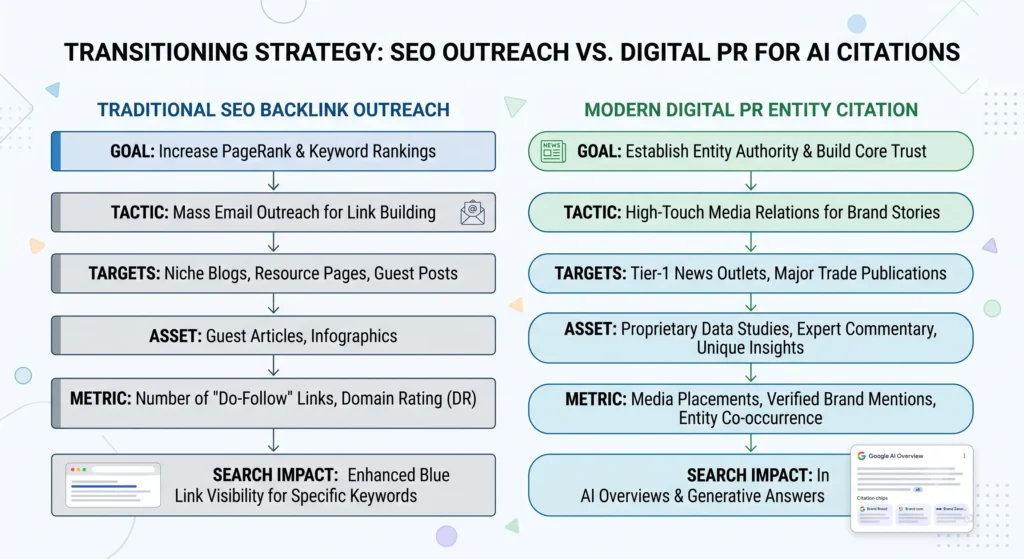
| Metric / Dimension | Traditional SEO Outreach | High-Trust Digital PR (GEO Era) |
| Primary Objective | PageRank pass & keyword anchor text | Entity authority, brand sentiment, & AI citations |
| Target Sites | Any website with high DR/DA metrics | Tier-1 news, trade journals, & cited reference hubs |
| Link Requirement | Hyperlink mandatory (do-follow) | Unlinked brand mentions carry strong corroboration weight |
| Content Asset | Generic guest articles & infographic roundups | Proprietary data studies, original surveys, & expert commentary |
| Algorithmic Role | Indexing signal & PageRank transfer | LLM training corpus weight & RAG retrieval source |
Why AI Engines Prefer High-Trust Media Sources
LLMs do not treat your website as an unbiased source of truth. When you say your product is the industry standard, it is an unverified marketing claim. When Forbes, Reuters, or a leading niche publication names your product as the benchmark, it becomes a corroborated entity fact.
[Your Website: Claims Authority]
               ↓
    (AI demands verification)
               ↓
[Digital PR: Tier-1 Mentions + Trade Journals + Industry Studies]
               ↓
[LLM Grounding Layer: Extracts Entity Associations]
               ↓
[AI Answer Engine: Cites Brand in Answer Chips]
According to Google Search Central’s guidance on AI search, search and generative systems reward content that demonstrates direct expertise, authoritative consensus, and verifiable sourcing.
How to Build a PR Engine That AI Can’t Ignore
To feed the retrieval engines that power modern AI summaries, execute campaigns focused on citation-worthy assets.
- Run Proprietary Data Campaigns: Survey 500+ professionals in your space or aggregate anonymized internal customer trends. AI engines love specific statistics, percentages, and hard numbers.
- Position Named Subject-Matter Experts (SMEs): Pitch original commentary to journalists covering breaking industry shifts. When journalists quote your founders, LLMs tie those entity associations directly to your domain.
- Target the Grounding Publications: Identify the top 5 to 10 trade publications that repeatedly appear in AI Overviews for your niche keywords. Prioritize relationship-building with journalists at those specific outlets.
- Structure Your On-Site Data Hooks: When media outlets cover your study, make sure your on-page summary answers the core finding directly within the first two sentences using clear Schema markup (
Article,Dataset,Organization).
Shifting focus from cold, scalable email blasts to genuine, newsworthy media coverage builds a defensible moat. High-trust PR feeds traditional rankings and ensures your brand remains the source AI engines quote when your customers ask questions.
Frequently Asked Questions
What is the difference between SEO outreach and Digital PR?
Traditional SEO outreach targets high-volume guest posting and link exchanges primarily to manipulate search engine PageRank with keyword-rich anchor text. Digital PR focuses on generating newsworthy stories, proprietary data studies, and thought leadership that earn organic coverage in authoritative publications and establish brand credibility.
Do unlinked brand mentions help with AI search visibility?
Yes. Large language models (LLMs) and retrieval-augmented systems process text semantically rather than relying solely on hyperlinks. When trusted media outlets repeatedly mention your brand in connection with a specific industry, problem, or solution, the AI recognizes that entity relationship as a verified fact.
How do AI engines decide which sources to cite?
Generative engines prioritize sources that show high factual consensus, recognized domain expertise, and primary research. When an AI synthesizes an answer, it pulls from grounding indexes that favor primary sources, original surveys, and tier-1 trade publications over secondary summary blogs.
Are traditional backlinks obsolete for Generative Engine Optimization (GEO)?
No. Traditional backlinks remain essential for maintaining baseline domain authority and crawling priority in core search indexes. Digital PR satisfies both requirements: it earns editorial backlinks that boost standard search rankings while securing the semantic citations needed for AI answer engines.