
Introduction: The Death of Traditional SEO (The GEO Era)
For over a decade, the rules of SEO were clear: find the right keywords, optimize your meta descriptions, structure your headers, and build quality links to land a spot in the top ten “blue links.” But if you have looked at a search results page lately, you already know that world is shrinking fast. Google has aggressively rebuilt its entire core search engine around generative AI and machine learning.
We are living through a massive architectural shift. It is no longer just about Search Engine Optimization; it is about Generative Engine Optimization (GEO). The algorithms are no longer merely matching keyword phrases—they are extracting, synthesizing, and summarizing information on their own. If your content isn’t built for AI model extraction, your organic traffic faces a steep decline.
Let’s break down the 5 recent foundational updates Google has introduced to this AI search ecosystem and exactly how you need to adapt to keep your traffic alive.
Core Body: The 5 Major AI SEO Updates
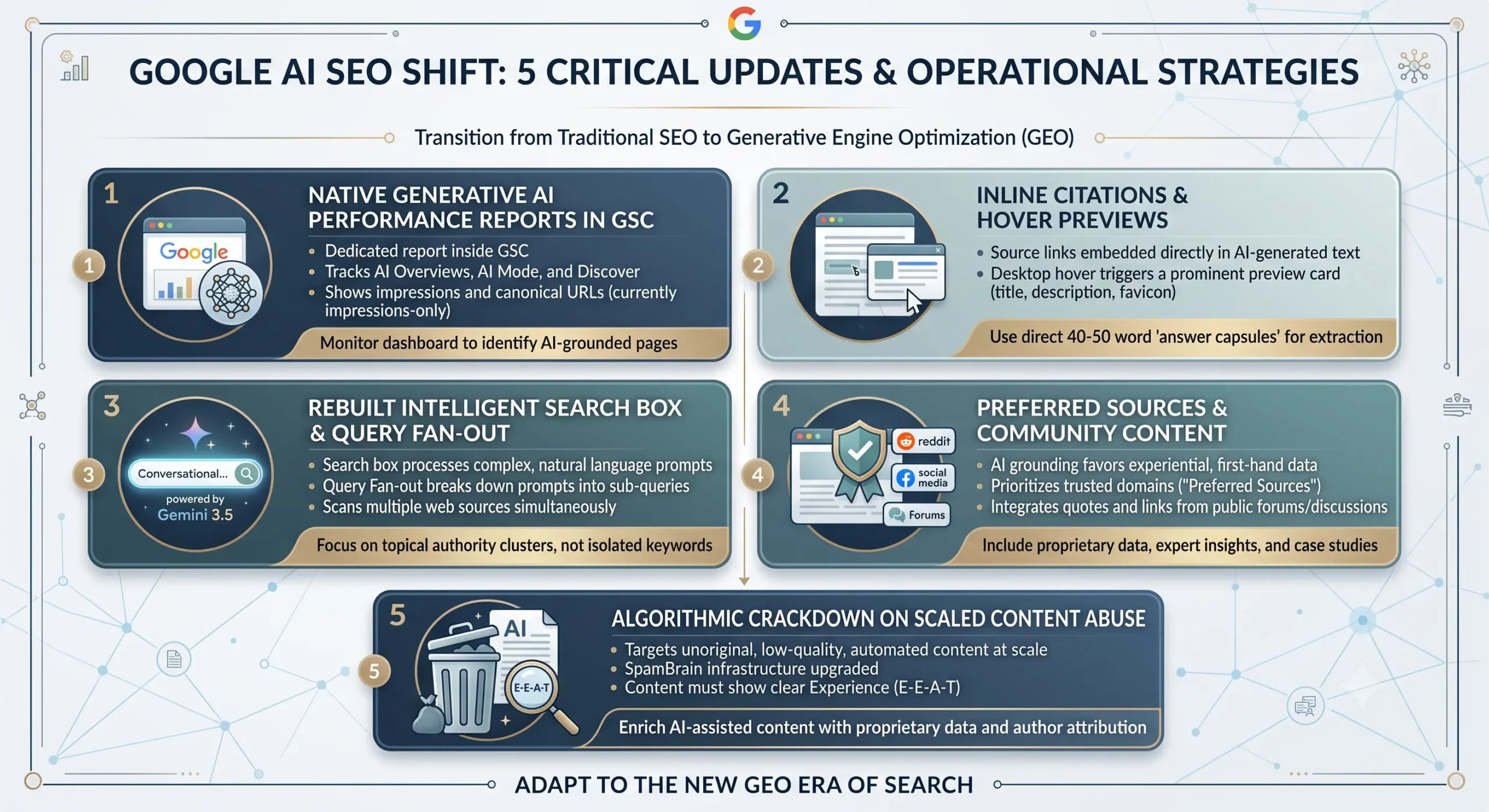
## Update 1: Native “Generative AI” Performance Reports in GSC
For months, webmasters were left completely in the dark, guessing how often their sites were being used to fuel conversational answers. Google has finally answered the call by officially launching a dedicated Generative AI Performance Report directly inside Google Search Console (GSC).
- The Breakdown: This new dashboard provides SEOs with a clean breakdown that explicitly separates traditional organic search data from generative interactions.
- Data Dimensions: You can now track your brand’s digital footprints across three key surfaces: AI Overviews, AI Mode, and generative features inside the Google Discover feed. It lists metrics like impressions by date, geographic origin, and device type.
- The Catch: Do not expect a complete analytics solution just yet. This is currently an impressions-only dashboard. While you can see the exact canonical URLs Google used to “ground” its AI responses, you cannot see Click-Through Rates (CTR), direct clicks, or the specific conversational user prompts. Treat it as a tool to benchmark which pages are successfully feeding the AI models.
## Update 2: Inline Citations & “Hover Previews” in AI Overviews
When Google first rolled out generative answers, publishers panicked. The initial layouts buried source links at the bottom, creating a “zero-click search” trap that starved content creators of traffic. To combat this massive industry pushback, Google completely redesigned how links are presented within AI results.
- The UI Mechanics: Instead of forcing users to scroll to the bottom, Google now embeds source links inline, directly within the generated text, sitting right next to the relevant sentence.
- The Desktop vs. Mobile Shift: On desktop browsers, hovering your mouse over an AI citation now triggers a highly prominent hover preview card. This card instantly displays the article title, a short description, and the site’s favicon. On mobile devices, source icons are placed prominently right inside the text flow to encourage direct clicks.
- Actionable Strategy: To win these embedded citations, stop hiding your main points behind walls of text. Place a crisp, direct 40-to-50 word “answer capsule” immediately beneath your H2 or H3 natural-language subheadings so the AI can easily extract it.
## Update 3: The Rebuilt “Intelligent Search Box” & Query Fan-Out
At its latest I/O event, Google introduced the largest structural upgrade to its core search box in over a quarter-century. The input field isn’t just a text box anymore; it is a fully conversational, multimodal workspace powered natively by the Gemini 3.5 Flash model.
- The Tech Shift: Because the input layer is now an LLM, it handles complex, multi-layered conversational prompts smoothly using a process called Query Fan-out. Instead of looking at your search as a single phrase, the AI dynamically breaks a multi-part question down into multiple sub-queries, scanning distinct web sources simultaneously to assemble a unified response.
- SEO Impact: Old-school keyword stuffing is officially dead. Because the engine handles multi-layered intent, it heavily favors websites built on comprehensive topical authority networks. You need to stop optimizing for standalone keywords and start building deep, interconnected content clusters that answer logical follow-up questions organically.
## Update 4: Expansion of “Preferred Sources” & Community Content
Google’s grounding algorithm has shifted focus away from generic, textbook-style informational summaries. The system is now heavily prioritizing user-first, experiential data that proves real-world utility.
- Preferred Sources: The core engine now natively incorporates a personalization layer known as Preferred Sources within AI Overviews. If a searcher frequently visits, interacts with, or signals trust toward a specific digital publication, that domain receives immediate priority mapping in their personalized AI search results.
- Social & Forums Integration: Informational summaries are no longer drawn strictly from standard blogs. Google’s generative answers now natively incorporate quotes, creator handles, and direct links from public forums, social media, and Reddit discussions. The algorithm intentionally searches for real-world human perspectives to back up its assertions. To survive, you must inject unique human case studies and proprietary data that LLMs cannot scrape from generic web pages.
## Update 5: Algorithmic Crackdown on “Scaled Content Abuse”
While this isn’t a front-facing user feature, Google’s latest algorithmic updates represent a massive war against low-quality, automated web clutter.
- The Target: Google upgraded its automated SpamBrain infrastructure to explicitly target what it defines as scaled content abuse. This is the practice of utilizing LLMs to mass-produce hundreds of thin, unoriginal articles a day solely to manipulate search engine rankings.
- The E-E-A-T Defense: Let’s be clear: Google does not ban AI-assisted content outright. However, it will ruthlessly filter it out if it lacks original value. The system heavily prioritizes the “Experience” aspect of E-E-A-T. Your content will only survive these updates if it is thoroughly enriched with proprietary data, first-hand practitioner insights, expert quotes, and explicit author attribution.
Summary Action Matrix (GEO Checklist Table)
| AI Search Update | Core Operational Impact | Immediate Optimization Priority |
| GSC Generative AI Report | Tracks AI grounding URLs but completely hides CTR data. | Benchmark which pages are successfully feeding the AI models. |
| Inline Hover Citations | Links are embedded natively right next to AI sentences. | Place a direct 40–50 word summary block right under your main H2/H3 headings. |
| Query Fan-Out Infrastructure | Multi-layered, conversational parsing replaces static keywords. | Transition from isolated keywords to comprehensive topical authority networks. |
| Preferred & Community Sources | AI results favor trusted individual domains and forum advice. | Inject original human case studies and real-world practitioner insights. |
| Scaled Content Filters | SpamBrain targets unoriginal, high-volume LLM-generated text. | Focus strictly on content depth and proprietary data rather than publishing volume. |
Conclusion & Next Steps
Make no mistake: generative AI search is not a distant, future threat you can afford to deal with next year. It is the active blueprint of modern web discovery. The search landscape has permanently transitioned from matching text strings to evaluating structured context.
If you want to protect your digital presence and ensure your traffic continues to grow, you need to stop passive tracking. Take action today: run an audit on your website template’s HTML cleanliness to make it easy for scrapers to parse, ensure you are avoiding “div soup,” and open up your Google Search Console dashboard. Check to see if your site has crossed the impression threshold required to view the brand-new Generative AI performance tab. The tools are live—use them to optimize on your own terms.