
Have you ever asked ChatGPT, Perplexity, or Google’s AI Overviews to describe your brand, only to find it got your core offer completely wrong?
Maybe it labeled your enterprise software as a “cheap, basic tool.” Maybe it lumped you in with low-quality competitors you outgrew five years ago. Or worse, maybe it confidently warned users about a bug or missing feature you fixed back in 2021.
When this happens, it is usually not a random glitch. It is a problem known as bad entity association.
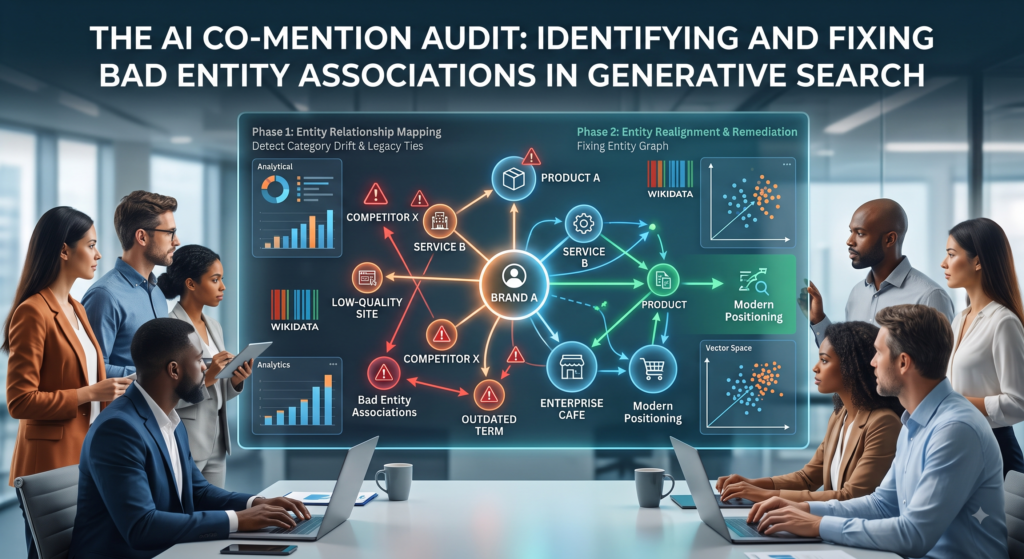
Traditional search engines rely heavily on matching keywords on a page. Generative AI engines think in terms of entities (distinct people, places, brands, or concepts) and co-mentions (how frequently and contextually two entities appear together across the web).
If the internet frequently mentions your brand next to the wrong concepts, AI models treat that association as a fact.
Let’s break down what bad entity associations look like, how to spot them, and how to fix your brand’s digital footprint so AI engines represent you accurately.
Key Terms to Know First
- Entity: A distinctly identifiable “thing” with unique attributes—such as a brand, person, product, or concept (e.g., HubSpot, CRM, or Inbound Marketing).
- Generative Engine Optimization (GEO): The practice of optimizing your brand’s digital presence so AI answer engines (like ChatGPT, Gemini, Perplexity, and AI Overviews) mention, cite, and recommend you accurately.
- Vector Proximity: A mathematical way AI measures how closely related two ideas or brands are in its memory. Brands mentioned in similar contexts sit closer together in vector space.
- Knowledge Graph: A structured database of interconnected real-world entities and relationships (like Wikidata or Google’s Knowledge Graph) that helps machines understand facts.
Common Types of “Bad” Entity Associations
Before you run an audit, it helps to understand the specific ways AI models misclassify brands.
1. Category Drift (The Wrong Tier)
This happens when an AI classifies your company into the wrong market bracket. For example, if you run a premium, high-security enterprise platform, but the AI consistently includes you in “Best Free & Budget Tools for Beginners” listicles.
2. Legacy Baggage (The Outdated Footprint)
AI models train on vast amounts of historical data. If you rebranded, pivoted services, or retired an old product tier three years ago, the AI might still pair your brand entity with deprecated features or past controversies.
3. Guilt by Association (Low-Quality Neighbors)
If your brand frequently appears on low-tier affiliate comparison sites, scraper blogs, or spammy “Top 50 Alternatives” lists alongside sketchy tools, the AI learns that you belong to that low-trust neighborhood.
4. False Equivalence (Misaligned Competitors)
The AI groups you with companies that solve completely different problems just because you share a couple of broad industry keywords. For instance, a dedicated cybersecurity monitoring suite getting lumped together with basic consumer antivirus software.
Phase 1: Identifying & Auditing Your Entity Associations
To find out what the AI thinks about your brand, use a mix of prompt testing and structured data checks.
- Reverse-Prompting AI Models: Run direct tests across ChatGPT, Perplexity, Gemini, and Google AI Overviews using targeted prompts:
- “What are the top 3 drawbacks of using [Brand]?”
- “Group these 10 brands by company size/tier: [List 9 competitors + Your Brand].”
- “What type of customer is [Brand] NOT suitable for?”
- Third-Party Citation Reviews: Search for pages where your brand is repeatedly co-cited. Look at review platforms (G2, Capterra, Trustpilot), Reddit threads, and popular industry roundups to see who you are regularly placed next to.
- Knowledge Graph & NLP Checks: Use tools like Google Cloud Natural Language API to paste in your homepage or “About Us” copy and inspect which entities the model extracts and associates with your text.
Phase 2: The Remediation Playbook (Fixing the Graph)
Once you spot inaccurate associations, you need to deliberately update both your owned content and your external web presence.
- Strengthen Structured Data (Schema): Use explicit JSON-LD schema on your website. Add properties like
sameAspointing directly to your authoritative Wikidata, LinkedIn, or Crunchbase profiles, and useknowsAboutto define your exact niche. - Publish Clear Disambiguation Pages: Create dedicated comparison and positioning pages on your own website (e.g., “Why [Brand] is Built for Enterprise, Not Solo Freelancers” or “Our Migration Away From [Legacy Feature]”).
- Prune Legacy Owned Content: Audit your old blog posts, case studies, and press releases. Update or delete content that repeatedly pairs your brand with outdated terms or deprecated offerings.
- Seed High-Authority Co-Mentions: Run targeted digital PR, podcast interviews, and guest contributions where your brand is explicitly mentioned alongside tier-one industry leaders and modern terminology.
Phase 3: Monitoring Entity Health
Fixing your entity footprint is an ongoing maintenance task rather than a one-time fix.
- Run Monthly Prompt Audits: Keep a spreadsheet of standard prompts and check every month whether the AI’s categorization and tone have shifted.
- Track Citation Sources: Look at the direct footnote links inside Perplexity and AI Overviews. Ensure they are pulling from your modern documentation, fresh case studies, or reputable industry outlets rather than outdated third-party roundups.
Conclusion & Key Takeaways
Generative search engines evaluate how your brand connects with other concepts, categories, and competitors across the web. Inaccurate co-mentions can misposition your business in AI-generated answers, leading potential customers to the wrong conclusions before they ever reach your website.
- Proximity Over Keywords: AI engines group brands based on semantic neighborhood and training data associations, not keyword density.
- Audit Adversarially: Test multiple AI models (ChatGPT, Perplexity, Gemini) with neutral and probing prompts to surface hidden misalignments, outdated features, or wrong-tier groupings.
- Fix Both Owned & Off-Page Signals: Combine structured schema (
sameAs,knowsAbout) on your site with digital PR and updated third-party citations to realign your entity graph. - Entity Management is Ongoing: Regular monthly audits ensure new product launches, pricing shifts, and rebrands stay accurately reflected in LLM memory.
Frequently Asked Questions (FAQs)
1. How is an AI Co-Mention Audit different from a regular backlink audit?
A backlink audit focuses on technical domain authority and link equity for traditional page ranking. An AI Co-Mention audit looks at contextual associations—evaluating which brands, pricing tiers, and topics AI models mention alongside your brand, even without an active hyperlink.
2. How long does it take for AI engines to update after fixing bad entity data?
Retrieval-augmented engines (like Perplexity and Google AI Overviews) can reflect updated citations within a few days to weeks once new pages are indexed. Core model memory in static LLMs takes longer, typically updating during subsequent model training runs or continuous fine-tuning cycles.
3. Can bad entity associations hurt my traditional SEO rankings?
Indirectly, yes. While traditional search still relies on ranking factors like backlinks, search engines increasingly use entity-based knowledge graphs to understand topical authority. Persistent confusion around your core niche can dilute your domain’s topical relevance across both search types.
4. What is the fastest way to fix category drift for my brand?
Update your primary knowledge hubs first: publish clear comparison and positioning content on your site, add explicit Organization JSON-LD schema, and correct your category classifications on major third-party review platforms (G2, Capterra, Wikidata) where AI crawlers source structured facts.