
If you’ve bought anything online over the last decade, you know the routine: you see an ad on social media, click a link, wait for a landing page to load, select a product, add it to your cart, fill out a long checkout form, and finally hit “Pay.”
For a long time, this was the gold standard of digital marketing. Marketers called it the sales funnel.
There’s just one problem: that traditional funnel is rapidly dying.
Today’s online shoppers are impatient, easily distracted, and weary of long checkout processes. Every time you make a potential buyer click a new link or wait for a page to load, you give them a reason to walk away.
Enter Shoppable Video Commerce—the trend that is replacing the traditional sales funnel by merging entertainment, product demonstration, and instant purchasing into a single, seamless experience.
Here is a beginner-friendly breakdown of why traditional funnels are losing steam, what shoppable video actually is, and how you can use it to turn casual viewers into instant buyers.
Also Read: Google Ads vs. Meta Ads: Which Should You Use in 2026?
1. What Is the Traditional Multi-Step Funnel (And Why Is It Failing?)
To understand why shoppable video works so well, we first need to look at what went wrong with the traditional approach.
A standard online purchase path usually looks something like this:
- Discovery: The customer sees a static picture or video ad on social media.
- The Click: They tap a button to leave the app and open an external landing page.
- Browsing: They land on your website and scroll through text, images, and reviews.
- Cart Selection: They choose their size or color and click “Add to Cart.”
- Checkout: They enter their shipping address, payment details, and confirm the order.
The Problem: Drop-Off at Every Step
Think of this process like an obstacle course. With every single step, a portion of your audience gets distracted or changes their mind:
- The landing page takes 3 seconds too long to load? They leave.
- They get a notification from a friend mid-scroll? They leave.
- The checkout form asks for too many details? They leave.
This friction explains why traditional e-commerce landing pages average a modest conversion rate of 2% to 3%. You end up losing 97 out of every 100 people who clicked your ad in the first place.
2. What Is Shoppable Video Commerce?
Shoppable video removes the obstacle course entirely.
Instead of treating a video as a teaser that forces users to visit a separate website, shoppable video turns the video itself into the store.
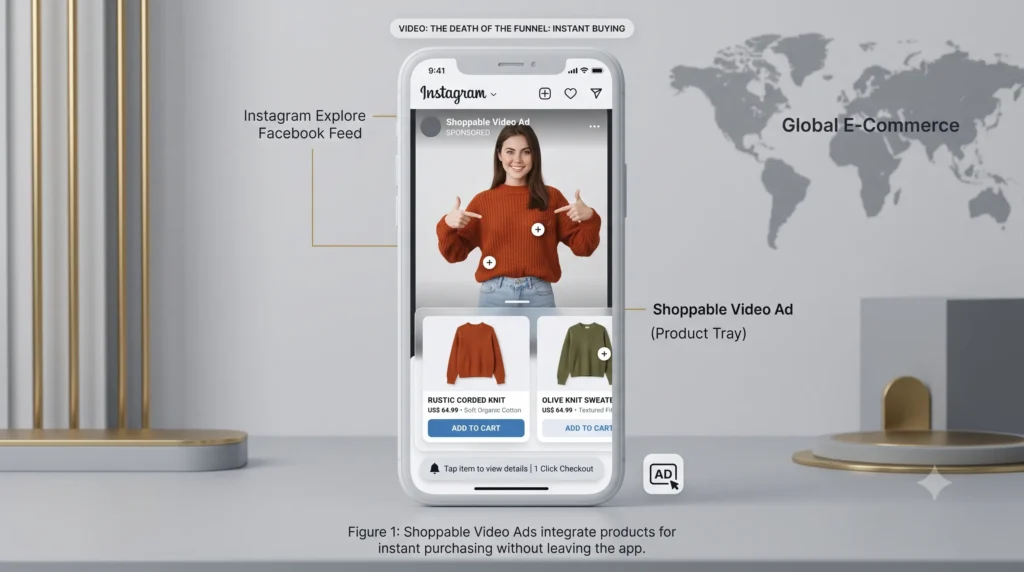
When someone watches a shoppable video—whether it’s a quick product demonstration, a styling tutorial, or an unboxing clip—they see clickable icons or product overlays directly on top of the media player.
If they like what they see, they can tap the product on screen to view details, select options, and check out without ever leaving or pausing the video.
3. The Psychology Behind Shoppable Video: Why It Works
Shoppable video isn’t just a flashy gimmick; it is built on how modern consumers naturally interact with content.
A. It Captures “Peak Intent”
When a shopper sees a product being demonstrated live or used in real life, their interest peaks immediately. In a traditional funnel, that excitement fades while waiting for a website to load. Shoppable video lets buyers act on impulse at the exact moment their excitement is highest.
B. It Answers Questions Visually
Static product photos can be deceptive. A high-quality video allows buyers to see how a fabric drapes, how a device actually works, or how a cosmetic shade looks on real skin. This visual clarity builds trust instantly.
According to research by McKinsey & Company, interactive video and live commerce formats can yield conversion rates approaching 30%—up to ten times higher than conventional e-commerce stores.
C. It Fits Mobile Habits
Over 70% of web traffic happens on smartphones. Tapping an interactive tag on a vertical short-form video feels natural for mobile users who spend hours scrolling through TikTok, Instagram, or YouTube Shorts every day.
4. The 3 Main Types of Shoppable Video
If you want to try shoppable video for your brand, you don’t need to reinvent the wheel. Marketers typically use three main formats:
1. Embedded On-Site Video Widgets
You can place short, vertical “TikTok-style” videos directly on your homepage or product pages using tools like Firework or Tolstoy. Visitors can tap through short video reviews or tutorials right on your site and buy products directly inside the player.
2. Native Social Shopping
Platforms like TikTok Shop and Instagram Shopping allow brands to tag products directly in organic posts, reels, and paid ads. The buyer completes the transaction using payment info already saved inside the social app.
3. Interactive Choice Videos (Quizzes & Decision Trees)
Some brands build interactive videos where the viewer chooses their own path (e.g., “Tap ‘A’ for dry skin or ‘B’ for oily skin”). Based on the viewer’s selection, the video automatically recommends a customized product bundle that can be added to their cart in one click.
5. How Beginners Can Start Using Shoppable Video
Getting started doesn’t require a Hollywood budget. In fact, raw and authentic videos usually outperform expensive, glossy commercials.
- Start with Your Top Sellers: Pick 2 or 3 of your most popular products that benefit from visual demonstration (e.g., clothing, beauty items, gadget tutorials, or home goods).
- Keep It Short and Focused: Keep clips between 15 to 45 seconds. Show the main benefit or problem the product solves within the first 3 seconds.
- Include a Clear Call to Action: Explicitly tell viewers what to do (e.g., “Tap the icon on screen to pick your color”).
- Test Native Features First: Before investing in software for your main website, test the waters using native features like TikTok Shop or Instagram Product Tags to see what resonates with your audience.
6. What Metrics Should You Track?
When moving away from traditional funnels, stop judging success purely by landing page views or raw web traffic. Keep an eye on these metrics instead:
- In-Video Click-Through Rate (CTR): What percentage of viewers tap on the featured product tags?
- Video Completion Rate: Are people watching enough of the video to see the product in action?
- Direct Conversion Rate: What percentage of video viewers complete a purchase?
- Average Order Value (AOV): Do shoppers buy more items when they see them demonstrated together in a video context?
The Big Picture
The digital landscape has shifted from “click-and-wait” to “watch-and-buy.”
Forcing customers to jump through multiple pages, forms, and redirects just to buy a product is a relic of the past. By bringing the checkout experience straight into the content itself, shoppable video eliminates friction, builds instant trust, and converts casual browsers into buyers in a matter of seconds.
Frequently Asked Questions
1. What is a traditional multi-step funnel?
It’s the traditional online buying process where a user sees an ad, clicks to an external website, views a landing page, adds an item to a cart, and completes multiple checkout steps.
2. Why are traditional sales funnels failing today?
Every extra click, slow page load, or complex form creates friction, causing impatient shoppers to get distracted or abandon their purchase before finishing checkout.
3. What is shoppable video commerce?
It is a format that embeds interactive product tags directly inside a video, allowing viewers to select options and buy items instantly without leaving the video player.
4. Do I need an expensive camera setup to create shoppable videos?
No. Raw, authentic, smartphone-shot videos (like unboxings, quick tutorials, and real-life demonstrations) often convert better than glossy corporate ads.
5. How does shoppable video improve conversion rates?
It removes drop-off points, captures buyers at their peak moment of interest, and visually demonstrates how a product works—leading to conversion rates up to ten times higher than traditional landing pages.